

Julianne Moore takes center stage at the festival's closing gala
The Royal Festival Hall hosted the UK premiere of The Debut on Sunday, October 18, bringing the 70th BFI London Film Festival to a close.
Jesse Eisenberg and Julianne Moore introduced the musical comedy to audiences following twelve days of international cinema screenings, discussions and industry events.
Eisenberg made his admiration for the leading actress clear. He explained that Mona Friedman had been written with Moore in mind, with her personality and abilities influencing the development of the role from the beginning.
Moore responded with equally enthusiastic praise, describing the screenplay as one of the best she had received throughout her career.
Variety reported the exchange on October 19 and noted that Paul Giamatti was unable to attend the London premiere. According to Eisenberg, the actor was absent because he had contracted Covid-19.
The London event was not the movie's world premiere. The Debut had already appeared at North American festivals in September, including Telluride and Toronto.
Nevertheless, selection as the closing film of such a prominent event represents significant recognition.
It should not be confused with winning the festival's official competition. That distinction belonged to Sergei Loznitsa's Imperium.
An overlooked woman discovers the power of being seen
Julianne Moore plays Mona Friedman, a reserved New Jersey housewife whose life has gradually become defined by the needs and expectations of other people.
She has grown accustomed to occupying very little space in her own world.
That changes when she auditions for a local musical production and unexpectedly receives a supporting role in a fictional show titled Nosy Neighbors.
The circumstances initially seem modest. Mona is not pursuing a Broadway career or attempting to achieve international fame.
She is joining a community theater company, complete with rehearsals, rivalries and artistic ambitions that can seem wildly disproportionate to the scale of the production.
For Mona, however, the experience represents a major personal transformation.
Someone is finally asking her to speak, perform and occupy a position where she will be watched.
The opportunity becomes increasingly unsettling when she falls under the influence of director Jerry Blankenbuehler and begins identifying too strongly with her fictional character.
The boundary between performance and everyday existence gradually weakens.
This supplies the film's central tension. Theater can help someone discover an identity, but the desire to become another person can also threaten the identity they already possess.
Eisenberg turns childhood memories into musical comedy
The Debut has deeply personal origins for Jesse Eisenberg.
Speaking to Reuters during the London event, the actor and director explained that the story was inspired by his childhood experiences of community theater.
He remembered the stage as a place where he found belonging during a period when he often struggled to feel comfortable in ordinary social situations.
That experience helps explain the film's interest in artistic communities.
The story is not merely about an inexperienced actress becoming excessively committed to a performance.
It explores the desire to belong to a group, share a creative activity and discover an environment where personal differences can become strengths.
Community theater offers particularly rich material for that exploration.
It brings together people who may not earn their living through performance but still dedicate considerable time and emotional energy to their artistic work.
The disparity between relatively modest professional stakes and enormous personal ambitions creates opportunities for comedy.
Eisenberg appears fascinated by this contradiction.
His characters do not need to confront global catastrophes. Their struggles involve recognition, emotional insecurity and the difficulty of understanding how others perceive them.
After the family relationships and questions of identity explored in A Real Pain, he returns to familiar concerns through a more openly musical and eccentric form.
Julianne Moore plays a character written specifically for her
One of the distinctive aspects of The Debut is its development process.
Eisenberg did not simply select a performer after finishing the screenplay. He has explained that he imagined Mona specifically for Julianne Moore.
This allowed him to create a character for an actress capable of moving from extreme restraint to powerful emotional expression.
Moore has considerable experience portraying women whose outward social identities conceal complicated psychological conflicts.
In The Debut, that quality becomes central to the transformation of someone who begins as an overlooked presence before assuming an increasingly dominant role within a theater group.
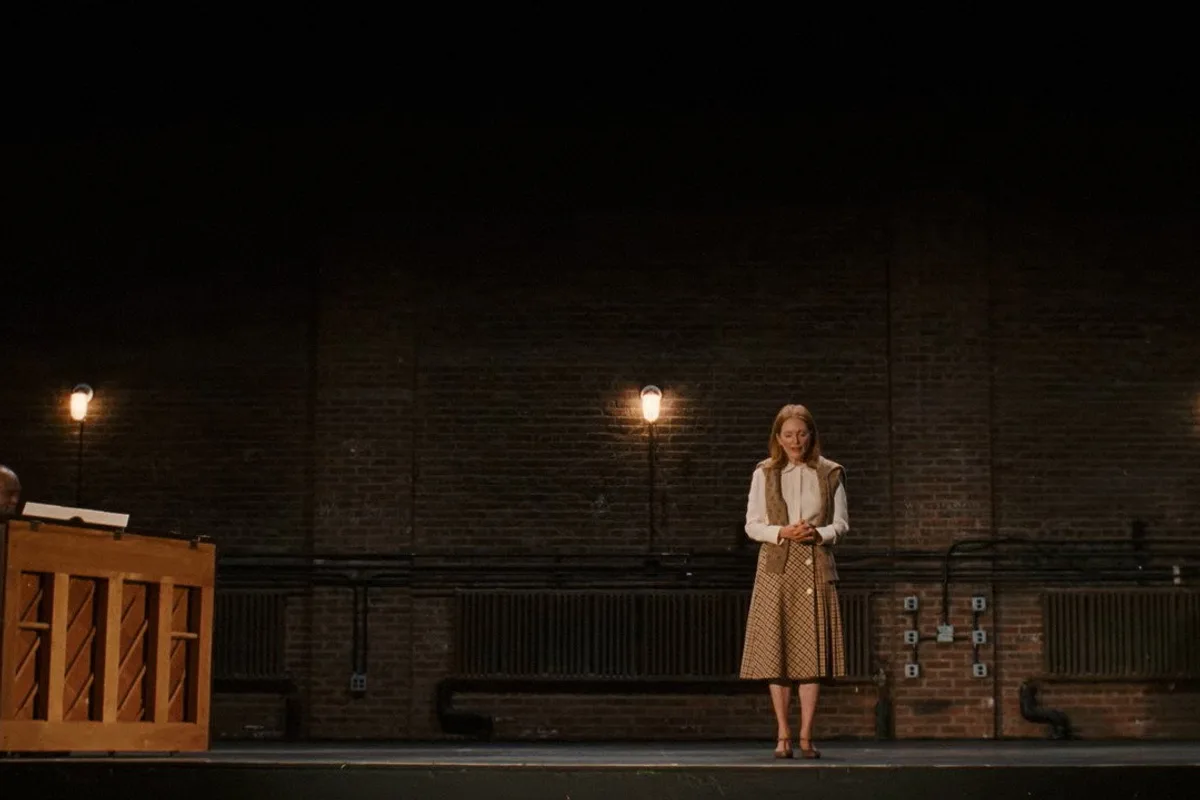
Early reviews have particularly praised the performance.
Time Out awarded the movie five stars, celebrating its humor and intelligence, while Variety emphasized the increasingly surreal nature of a story built around community theater.
The response is not uniformly enthusiastic. Other critics have questioned the tonal changes and the extent to which the film's eccentricity occasionally overwhelms its dramatic coherence.
Praise for Moore should therefore be distinguished from a complete critical consensus about the movie.
A commanding performance can anchor a film while still leaving room for disagreement about its storytelling.
Nevertheless, the mutual admiration between Moore and Eisenberg is clearly an important element of this collaboration.
Paul Giamatti portrays a demanding theatrical director
Mona's transformation takes place under the direction of Jerry Blankenbuehler, played by Paul Giamatti.
Jerry approaches the small local production with enormous seriousness, exercising considerable authority over the performers.
His influence becomes particularly important when he encourages Mona to pursue an increasingly immersive relationship with her fictional role.
Giamatti appears well suited to a character who combines intellectual confidence, authority and comic intensity.
In The Holdovers, he demonstrated his ability to portray demanding individuals whose certainties conceal personal vulnerabilities.
The Debut offers a different type of relationship.
Jerry represents the fascination a powerful artistic personality can exercise over someone discovering a new environment.
The film consequently explores the power dynamics within creative communities.
Even in amateur theater, prestige, hierarchy and the desire to impress can profoundly affect relationships.
That does not mean Eisenberg presents artistic communities as exclusively harmful.
His premise instead suggests that both things can be true.
Theater can offer belonging while also becoming a place where obsession and domination develop.
Seven original songs bring a fictional musical to life
The Debut is more than a comedy set around a theater company.
It contains a fictional musical titled Nosy Neighbors, featuring seven original songs written by Jesse Eisenberg.
The filmmaker confirmed the detail to Reuters during the London premiere, explaining his enthusiasm for traditional musical theater and his inspiration from productions associated with the 1990s.
Halle Bailey, known for portraying Ariel in Disney's live-action The Little Mermaid, joins an ensemble that also includes performers with substantial theatrical experience, such as Bernadette Peters.
The combination provides another source of comic contrast.
Professional performers portray members of a local company whose ambitions may be considerably greater than its resources.
The songs are therefore part of the fictional world rather than simply background music.
They belong to the environment that attracts Mona and helps explain why she becomes so deeply immersed in the performance.
This structure also allows Eisenberg to experiment with a more expressive filmmaking form than those of his previous features.
Eisenberg continues developing his identity as a director
The Debut represents another important step in Jesse Eisenberg's filmmaking career.
Long recognized for his acting roles in The Social Network and the Now You See Me franchise, he has increasingly developed a distinct identity behind the camera.
His first directed feature, When You Finish Saving the World, already focused on characters who struggle to communicate their emotions and understand those of others.
A Real Pain explored similar tensions through two cousins traveling in Poland while confronting personal differences and their family's Holocaust history.
That movie earned Eisenberg the BAFTA for Best Original Screenplay and an Academy Award nomination in the same category.
The Debut is his third feature as director.
Its form appears more playful, but the central preoccupations remain recognizable.
Characters want to be understood, accepted and appreciated, even when their attempts to achieve those goals complicate their relationships.
Community theater provides a tangible environment in which these emotional contradictions can be examined.
Casting Moore as the central figure also broadens Eisenberg's filmmaking perspective.
Rather than constructing another narrative primarily around a character resembling his own familiar screen persona, he places a woman at the heart of a story about social invisibility and recognition.
It suggests an effort to expand his creative range without abandoning the emotional interests of his earlier work.
Closing the London Film Festival is not the same as winning it
Selecting The Debut to conclude the London Film Festival carries symbolic significance.
The event is among Europe's major celebrations of international cinema.
Its 70th edition ran from October 7 to 18, 2026, and featured 251 works across features, short films, television, documentary and immersive media, according to the BFI.
Simon Stone's Elsinore opened the festival, while Eisenberg's theater-centered comedy provided its closing presentation.
That was an appropriate conclusion for an event built around bringing artists and audiences together.
However, closing-night selection is different from receiving a competitive prize.
The BFI awarded Best Film in the Official Competition to Imperium, directed by Sergei Loznitsa, a work examining the Soviet Union of the early 1970s through archival footage.
The Sutherland Award for a first feature went to 9 Temples to Heaven, the documentary prize to Concrete Land and the short-film award to Aman.
The distinction accurately establishes The Debut's place within the festival.
It was the prestigious closing gala presentation, not the winner of the main competition.
American theaters in December, British cinemas in January
Following its festival appearances, The Debut is scheduled to continue its theatrical journey.
A24 has announced an American release for December 11, 2026, while Lionsgate plans to distribute the film in British cinemas from January 15, 2027.
Those dates apply to specific markets and should not be automatically extended to other European territories.
A confirmed French theatrical release date was not established in the sources verified for this report.
The staggered schedule reflects the path of a movie generating attention through festivals before seeking a wider commercial audience.
Positive reviews and Moore's reputation may improve its visibility, but neither guarantees commercial success.
American audiences will soon be able to judge whether the enthusiasm expressed onstage in London matches the experience offered by the finished film.
The Debut explores the need to belong, even under the spotlight
The London premiere provides an interesting contrast between the film's subject and the circumstances of its presentation.
At the prestigious Royal Festival Hall, Julianne Moore and Jesse Eisenberg celebrated a story about amateur performers whose productions attract nothing like the attention of a major international festival.
Yet the two worlds share an essential question.
What motivates someone to step onto a stage and become another person, even temporarily?
Eisenberg seems to locate part of the answer in his childhood experiences.
Theater provided a sense of belonging, but he also understands how artistic commitment can produce extreme behavior.
Moore embodies that contradiction through Mona, a woman who discovers the pleasure of being noticed and gradually risks losing sight of what she originally hoped to find.
The film's thematic promise lies in that ambiguity.
Art can help someone discover a voice, yet the need for recognition can become another form of confinement.
With The Debut, Eisenberg is not simply telling a story about a theater group rehearsing a musical.
He is using performance to examine the insecurities, ambitions and contradictions of people desperate to occupy center stage.
The film has now left the spotlight of the London Film Festival.
Its next challenge will be less ceremonial: finding an audience in theaters, where a story about recognition must ultimately earn attention through the strength of its storytelling.