
Content Volume Is Not a Complete Strategy
Since its early-access launch in January 2024, Palworld has grown through several substantial updates.
New regions, creatures and systems have steadily expanded the experience.
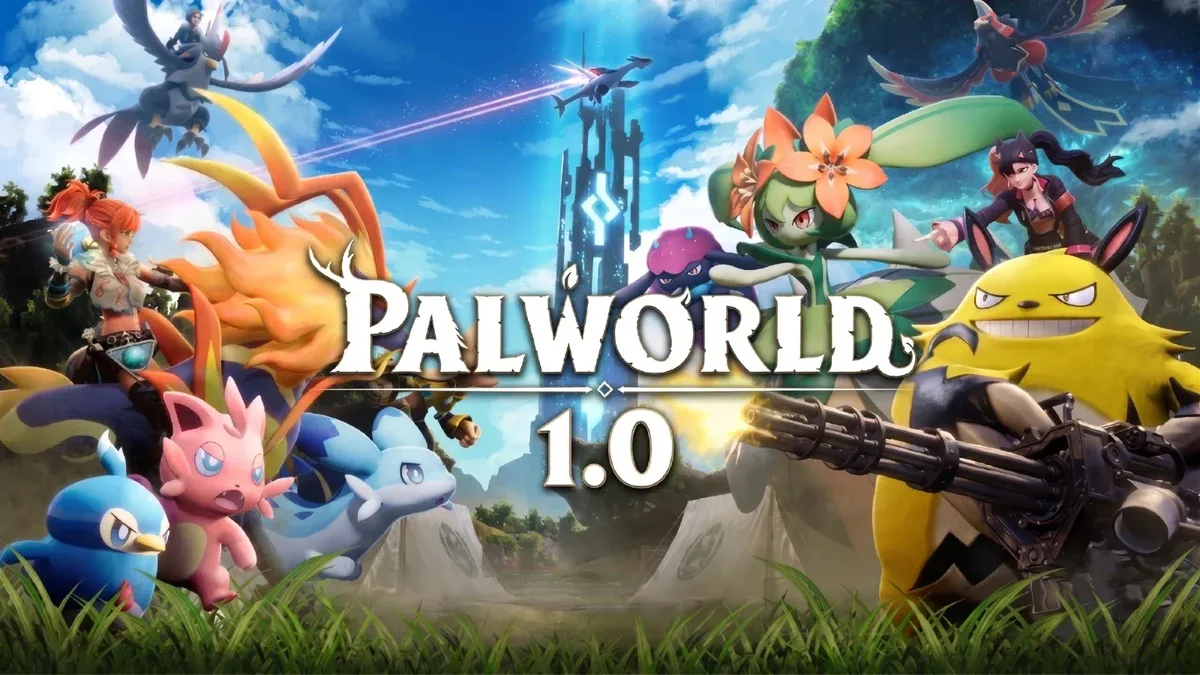
Version 1.0, released in July 2026, represented a major milestone.
It added 72 Pals, including 47 entirely new species and 25 variants.
Pocketpair has therefore demonstrated its ability to produce substantial quantities of new content.
However, the studio does not want that volume to become its permanent objective.
Buckley explains that developers do not view new Pals simply as numbers added to a roster.
Each creature should contribute something distinctive.
The position reflects a familiar challenge for continuously evolving games: the more content they accumulate, the more difficult it becomes to ensure each addition retains a meaningful purpose.
A Creature's Value Cannot Be Reduced to Combat Statistics
Buckley's criteria extend far beyond raw fighting strength.
A new creature may stand out through its design, behavior, abilities or usefulness in a base.
This reflects Palworld's structure.
Pals support exploration, combat and production automation.
Their value therefore cannot be measured through a single power ranking.
Maintaining several forms of usefulness could help Pocketpair prevent its roster from collapsing into a small selection of dominant options.
However, that intention must eventually be judged through actual balance changes and player behavior.
A design philosophy alone cannot guarantee diverse team compositions.
A Bigger Roster Makes Every Balance Decision Harder
At the time of the interview, MP1st described a roster containing more than 280 Pals.
That figure illustrates the increasing complexity of each update.
A new creature can change the value of an existing ability.
It may also transform combat strategies or improve particular base configurations.
Every addition therefore creates new interactions with previous systems.
Buckley confirms that Pocketpair studies gameplay data and community feedback after updates.
The information helps inform balance adjustments.
However, the studio does not disclose its precise statistical methods.
It is possible to identify a strategy of observation without quantifying its effectiveness or assuming all species remain equally useful.
Development Also Involves Rejecting Ideas
The latest comments connect with earlier explanations of Pocketpair's creature design process.
The studio produces numerous visual concepts.
These proposals undergo internal evaluation before selected designs advance to modeling.
Hundreds of concepts reportedly remain unused.
This selection represents creative work that players rarely see.
When an update introduces ten creatures, it does not necessarily reveal every idea imagined and rejected during production.
A roster's quality also depends on what developers choose not to release.
However, that means dedicating resources to designs that may never become commercial content.
Pocketpair Also Prefers Standalone Games
The philosophy has a parallel in the developer's broader expansion strategy.
In another interview published by MP1st on October 13, Buckley explained that Pocketpair does not necessarily want Palworld to become a platform containing every possible genre.
The company is developing Palworld: Palfarm, a separate game about agricultural life alongside Pals.
Pocketpair prefers giving some concepts their own products rather than turning them into additional modes within the original game.
The stated goal is to explore each idea through an experience designed specifically around it.
That does not amount to abandoning Palworld itself.
The studio continues working on its original game while considering other ways to develop the fictional universe.
A Different Approach From the Permanent Platform Model
Buckley's remarks have been compared with Fortnite's broader platform strategy.
Epic Games has developed different experiences within a shared ecosystem.
Pocketpair does not necessarily want to reproduce that structure.
Standalone development can provide greater creative independence.
A farming game can establish its own pacing and systems without needing to function as an extension of Palworld.
However, an independent product must also build its audience and commercial identity.
Pocketpair presents this decision as a creative preference.
It would be premature to conclude that one business model is universally superior to another.
Success Provides Freedom, Not Guarantees
Palworld's popularity gives Pocketpair opportunities to expand its franchise.
However, that position does not eliminate production constraints.
A larger creature roster requires animations, distinctive abilities and additional testing.
Standalone projects also require time and development resources.
Buckley's stated strategy is to prioritize ideas capable of producing meaningful new experiences.
The interviews do not provide budgets, sales forecasts or a complete timetable for upcoming projects.
Creative ambitions must therefore remain distinct from future financial results.
Palworld's Future Is More Than a Number
In the immediate term, the comments do not constitute a new update announcement.
No individual new species has been revealed.
Pocketpair has not announced a date for another roster expansion.
However, the developer is clarifying how it intends to approach future growth.
Pal counts will remain visible and easy to communicate.
But the success of an addition will also depend on whether it changes gameplay, encourages attachment and expands meaningful choices.
That approach may prove important to Palworld's longevity. Following such a substantial version 1.0, the question is no longer simply how many creatures Pocketpair can add, but how many will genuinely deserve a place in the game.