
A worldwide product launch followed immediately by organized play
Palworld OFFICIAL CARD GAME officially launched on July 30 in English, Japanese and Simplified Chinese. Bushiroad did not wait for several expansions to arrive before beginning to organize a community around the product.
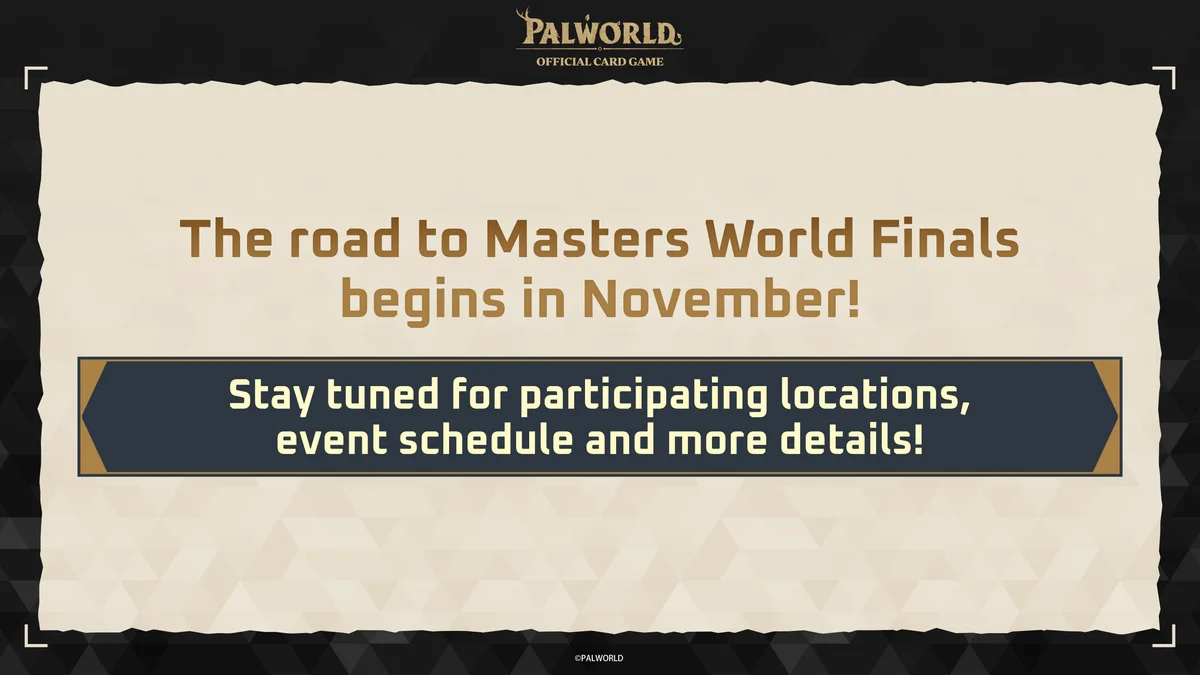
Shop Tournaments began in August alongside launch-focused events. Challengers Cup is scheduled to start in September, while the current competitive events page places the beginning of Masters League in November.
The stated objective makes the ambition clear. Bushiroad presents Masters League as a path where players around the world can battle for the chance to become the first Palworld OFFICIAL CARD GAME World Champion.
Competition also gives the product a reason to persist
A competitive circuit obviously exists to determine who plays best. For a TCG publisher, it is also infrastructure that gives players reasons to return to stores, test new cards and pay attention to future releases.
Local tournaments are designed to distribute recurring promotional cards. Higher-level competition creates an objective beyond collecting alone. Between them, Bushiroad can maintain continuous activity around a product that might otherwise depend almost entirely on the release rhythm of new booster sets.
That matters particularly for a property like Palworld. The video game can experience enormous peaks when major updates arrive, but a physical TCG operates on a different rhythm built around specialist stores, set releases, local events, collecting habits and competitive play.
The commercial roadmap is already designed around continuity
Bushiroad began with Dawn of Palpagos and two Trial Decks on July 30. The next wave is already scheduled: Sleeve and Card Set Vol. 1 arrives October 2, followed by second booster Legends Awaken on October 30.
Two more Trial Decks are planned for December 18, while another booster already has a January 29, 2027 release date. The competitive circuit is therefore not being built around a card pool intended to remain static.
Every new release can change strategies and challenge established decks. That is useful for competition, but it is also a familiar TCG business mechanism: organized play and the product calendar reinforce one another.
Palworld is doing more than lending its mascots to merchandise
The significance extends beyond Bushiroad. For Pocketpair and the Palworld property, the card game provides a way to move beyond the screen in a format designed to last rather than functioning as conventional merchandise.
The product attempts to translate several parts of the original game. Players lead teams of Pals, gather resources and use Structures, Gears, Events and Souls. Base construction and Pal assignment therefore receive mechanical counterparts in the physical card game.
That matters for a franchise extension. It is easy to sell familiar illustrations on collectible cards. Building a rules system where behavior associated with the original work still matters requires more effort and gives the product a better chance of developing an identity of its own.
The first world champion will also test the franchise
Palworld OFFICIAL CARD GAME obviously does not yet have the competitive history of the largest games in the category. Its first organized circuit is supposed to determine whether it can begin creating that history.
A lasting community does not appear simply because a publisher prints the words World Champion on an event graphic. It requires stores able to run events, players willing to travel, sufficiently stable rules and a metagame interesting enough for competitive results to matter.
Bushiroad has experience building those ecosystems and is moving quickly. For Palworld, however, the most important question is whether people eventually follow the tournaments for reasons beyond the logo printed on the cards.
If they do, the first world champion will represent more than the top player of one competitive season. It will mark the point where one of Palworld's most ambitious franchise extensions begins functioning as an independent community.