
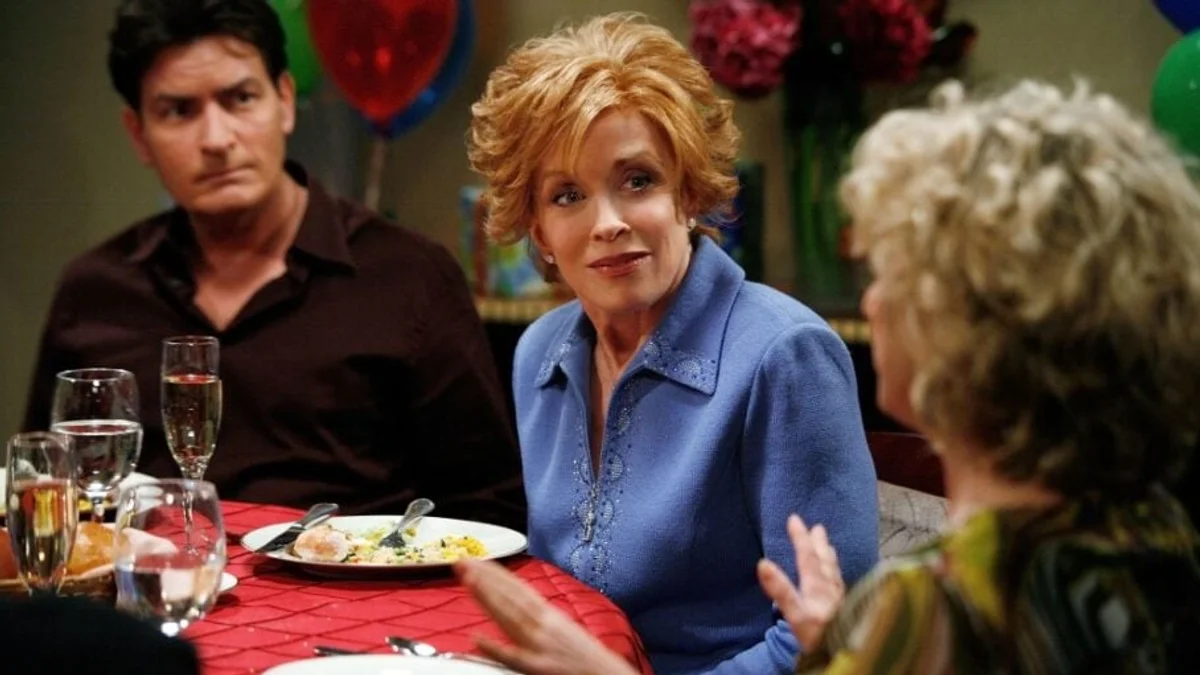
Evelyn Harper always knew how to get what she wanted. On Two and a Half Men, Charlie and Alan's mother could dominate a conversation with a smile and leave her sons uncomfortable with a perfectly timed remark.
Behind the scenes, Holland Taylor eventually made an equally determined decision.
After six seasons, she refused to renew her contract with the CBS sitcom.
The actress was not unhappy with every aspect of the production.
She enjoyed playing Evelyn and appreciated much of the work.
But she was dissatisfied with her compensation.
Speaking to Anthony Mason, Taylor said that four Emmy nominations had not resulted in a single raise.
When she decided against extending her agreement, the production team was reportedly astonished.
Her decision ultimately changed how she worked on the series without requiring her to abandon the character entirely.
Four Emmy nominations without a salary increase
Holland Taylor received four Primetime Emmy nominations for Two and a Half Men, in 2005, 2007, 2008 and 2010.
The recognition reflected the importance of her supporting performance in a sitcom largely centered on Charlie Sheen, Jon Cryer and Angus T. Jones.
But according to Taylor, those nominations did not produce the financial acknowledgment she expected.
In the October 21 episode of Alchemy with Anthony Mason, she said her salary had remained unchanged during the six years she worked under contract.
She also suggested that she was earning approximately what she had received for another television project several years earlier.
Taylor did not disclose her precise earnings per episode.
It is therefore impossible to calculate the difference between her compensation and that of her co-stars from her account alone.
Her dissatisfaction, however, concerned more than the amount itself.
She felt the production had failed to acknowledge her contribution financially despite years of work and repeated industry recognition.
Why Taylor declined another contract
The situation came to a head in 2009 when her existing agreement expired.
Taylor says the producers expected her to negotiate an extension.
Instead, she told them she no longer wished to remain under a regular contract.
According to her recollection, the production team replied that it could not offer her more money.
She explained that her decision was not simply a negotiating tactic intended to obtain a raise.
She wanted greater independence over her professional schedule.
That distinction is significant.
Taylor has not claimed that she was fired or excluded from the sitcom.
She says she personally chose not to renew her agreement.
It was therefore a professional decision made by the actress rather than a departure imposed by the show's producers.
The arrangement allowed her to maintain a relationship with the series without remaining committed to a regular production schedule.
She never truly left Two and a Half Men
Describing Taylor as having left the sitcom after Season 6 can create a misleading impression.
She did not permanently abandon Evelyn Harper.
Instead, she stopped working under a regular cast contract.
The production could still approach her about guest appearances.
But she was now free to accept or decline those invitations.
That arrangement allowed Evelyn to continue appearing in later seasons.
The character remained part of the Harper family throughout the show's long run.
For Taylor, the crucial difference was control over her calendar.
She could prioritize a theatrical production, another television role or a personal commitment without automatically having to accommodate Two and a Half Men's schedule.
That freedom was a central part of her decision.
It would therefore be inaccurate to say that she disappeared permanently from the cast in 2009.
Evelyn Harper was difficult to forget
In Two and a Half Men, Evelyn Harper is a wealthy businesswoman with a complicated relationship with her sons.
Charlie, played by Charlie Sheen, enjoys a comfortable lifestyle in Malibu.
His brother Alan, portrayed by Jon Cryer, regularly depends on Charlie's hospitality.
Their mother enters their lives with a confidence that often leaves both men unsettled.
Evelyn has a strong personality, a carefully maintained public image and an unconventional understanding of family affection.
She can be sarcastic, distant and remarkably manipulative.
But her appearances deepen the sitcom's central relationships.
She gives Charlie and Alan a shared history that helps explain their behavior.
Taylor made the supporting character immediately recognizable.
Her performance relied on precise dialogue delivery, carefully controlled silences and subtle reactions.
She could turn an ordinary remark into a comic humiliation without visibly changing her expression.
That control helped make Evelyn memorable despite her limited screen time compared with the principal cast.
One of CBS's most successful sitcoms
Created by Chuck Lorre and Lee Aronsohn, Two and a Half Men premiered in September 2003.
It quickly attracted a large audience through the contrasting personalities of Charlie, Alan and Alan's son Jake.
The show became an important part of CBS's comedy programming.
It also experienced significant cast changes.
Charlie Sheen left the series in 2011.
Ashton Kutcher joined in Season 9 as a new character, Walden Schmidt.
Despite that major transition, the sitcom continued until February 2015.
In total, it produced twelve seasons and 262 episodes.
Taylor participated in that history even after the end of her original contract.
Her experience illustrates a less visible aspect of American television.
The commercial success of a program does not guarantee that every performer enjoys comparable contractual conditions.
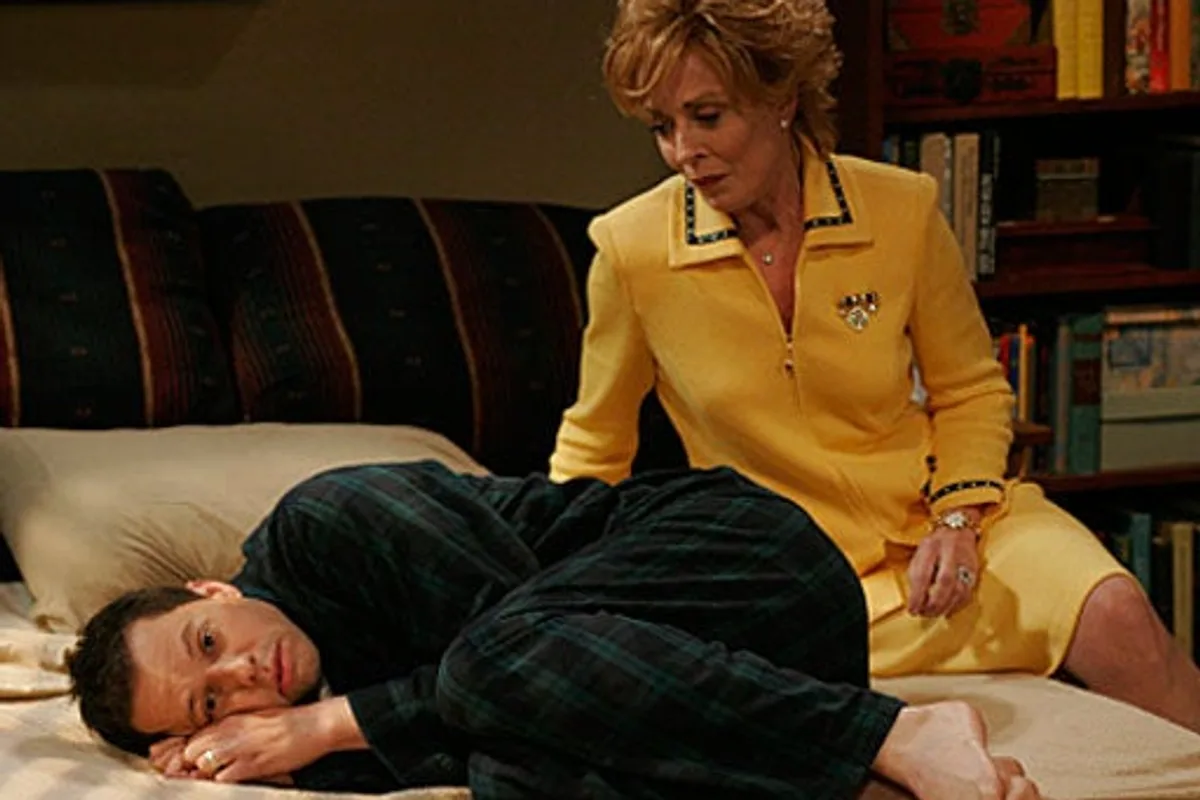
The pay gap inside successful television shows
Taylor's comments take on additional significance when considered alongside the salaries reportedly earned by some of the sitcom's stars.
Charlie Sheen negotiated exceptionally high fees at the height of Two and a Half Men's popularity.
Jon Cryer also received improved financial terms during the show's run.
However, figures reported by entertainment publications should not be confused with a complete, independently verified record of the cast's contracts.
An actor's compensation may depend on several factors.
Guaranteed episode counts, billing, seniority, individual negotiations and studio commitments can all influence the terms of an agreement.
Taylor's testimony does not by itself establish a particular case of unlawful pay discrimination.
It does reveal an imbalance that she believes she personally experienced.
She felt her contribution had not been recognized financially despite the character's visibility and the awards attention her performance received.
Her complaint also concerns professional respect
Taylor does not describe her experience as exclusively a financial dispute.
She acknowledges that she enjoyed many aspects of the sitcom.
But she also criticizes what she saw as a lack of consideration from the people managing the production.
That observation helps explain why she declined to continue under contract.
Taylor already had a substantial career when she joined Two and a Half Men.
She was not a newcomer depending entirely on a first major role.
She had enough professional experience to regard independence as an important part of her working life.
By choosing occasional appearances, she accepted a less regular presence on screen.
In exchange, she gained greater freedom over her commitments.
Her decision demonstrates that compensation is not always the only consideration.
For some performers, control over their time and acknowledgment of their work can become just as important as a higher fee.
Taylor had already won an Emmy before the sitcom
Holland Taylor's career began long before Two and a Half Men.
She appeared in Bosom Buddies, the television comedy that featured a young Tom Hanks.
She also played a prominent role in The Practice, earning the 1999 Primetime Emmy Award for Outstanding Supporting Actress in a Drama Series.
Movie audiences may recognize her from Legally Blonde and other Hollywood productions.
Her professional background includes theater, television and film.
That variety helped make it possible for her to imagine a career beyond one successful sitcom.
She had other ways to continue performing.
Her Emmy nominations for Evelyn Harper offered additional recognition, but they were not the only validation of her work.
She had already built an extensive career across several decades.
The stage offered another form of independence
One of Taylor's most significant projects outside television is Ann.
The actress wrote and performed the play about former Texas Governor Ann Richards.
The production demonstrates a particularly personal relationship with her craft.
Rather than waiting for a studio to offer her another character, Taylor helped create a role for herself.
The show reached Broadway and earned her a Tony Award nomination in 2013.
That experience illustrates the kind of artistic independence she could pursue.
On stage, she was not limited to a supporting part within a television ensemble.
She carried an entire production, with the responsibilities and risks involved.
It would nevertheless be simplistic to present Ann as a direct consequence of her disagreement with CBS.
The play had its own creative development.
But it demonstrates that theater and other artistic opportunities occupied an important place in Taylor's career as she moved away from the obligations of a regular sitcom contract.
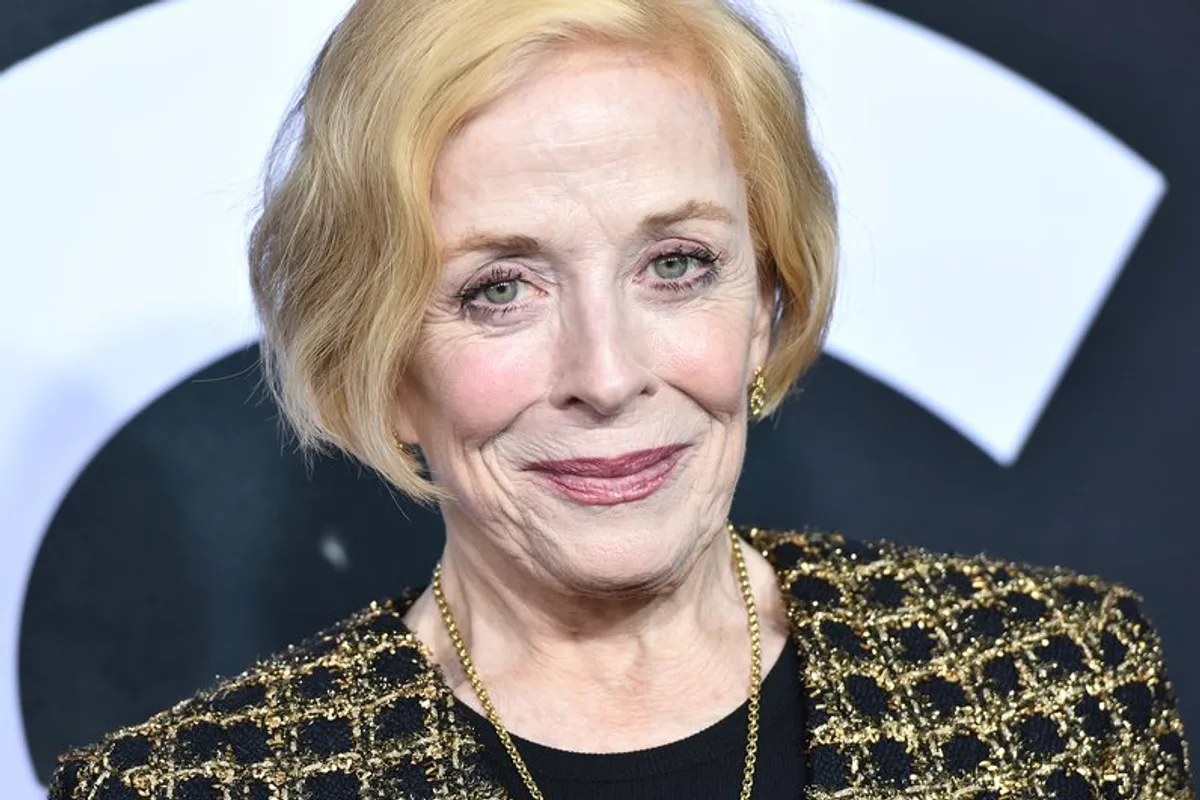
Why is she discussing it again in 2026?
Taylor's comments come as the actress continues working at the age of 83.
She appeared on Alchemy with Anthony Mason to discuss her career, artistic education and current projects.
The October 21 episode was not exclusively about Two and a Half Men.
Taylor also revisited her theatrical beginnings, her training with Stella Adler and her early work alongside Tom Hanks on Bosom Buddies.
The conversation was connected to the promotion of Brothers, an Apple TV comedy featuring Matthew McConaughey and Woody Harrelson.
Her comments about Evelyn Harper were therefore part of a broader reflection on her professional life.
Taylor was examining decisions that helped her continue working according to her own priorities.
That context matters.
Her appearance should not be portrayed simply as a new attack on a television show that ended more than a decade ago.
She was describing a decision made in 2009, with the perspective provided by a long career.
She is not eager to play Evelyn again
Just before the podcast episode was released, Taylor had also discussed Two and a Half Men on Today.
During her October 13 appearance, she was asked whether she would want to revisit any of her earlier characters.
Her reaction to the possibility of playing Evelyn Harper again was far from enthusiastic.
That response does not constitute an official announcement about a potential revival of the sitcom.
No new season or confirmed revival involving Taylor has been established by these comments.
But her attitude is consistent with how she now reflects on the production.
She recognizes the value of the work while expressing little interest in returning to the same long-term arrangement.
The actress appears more interested in exploring new characters than in indefinitely extending a past success.
A salary dispute that became a question of choice
Taylor's account clarifies a career decision that could easily be misunderstood.
After six seasons, she was not permanently removed from Two and a Half Men.
She chose to stop working under a regular contract.
According to her testimony, the absence of salary increases despite her Emmy nominations contributed to that decision.
But she also wanted the freedom to decide when and how she worked.
The producers could still invite her to return.
She could accept or refuse.
That distinction changes how her later appearances should be understood.
Her reduced presence was not an unexplained disappearance.
It was the result of a deliberate professional choice.
Behind Evelyn Harper's sharp dialogue, Holland Taylor now offers a reminder of a practical reality of acting: being recognized by an audience does not necessarily mean feeling recognized by an employer.