
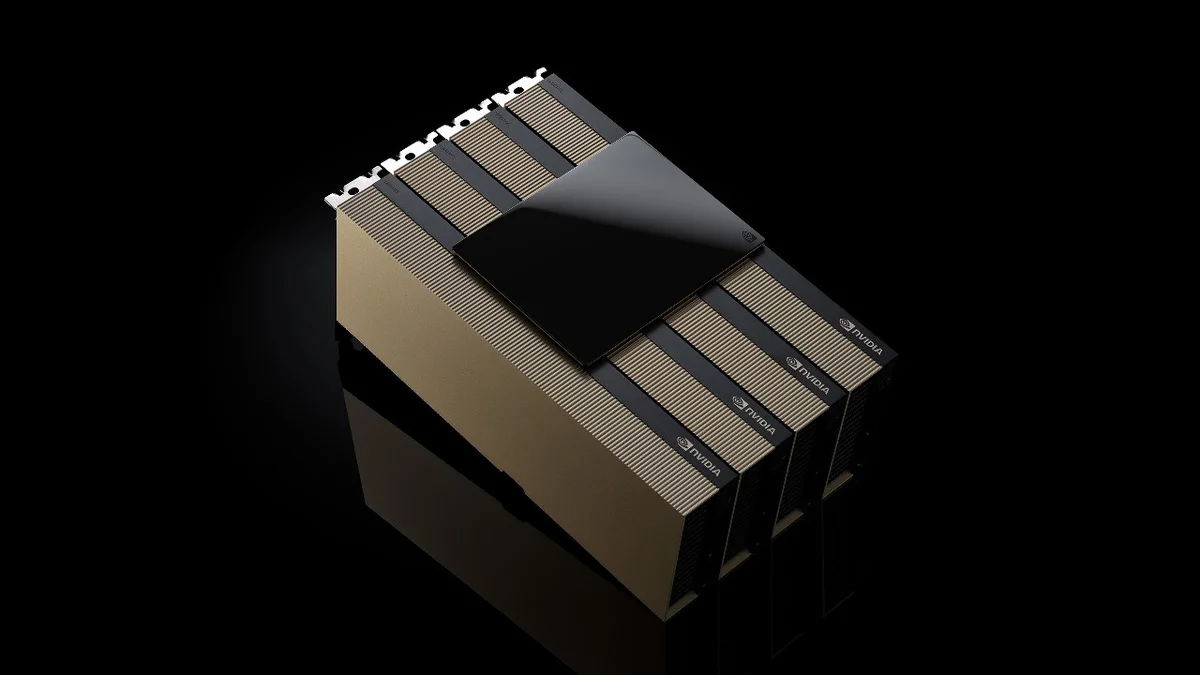
The first shipments are real; the 10,000-unit figures need an asterisk
A U.S. Commerce Department official confirmed in July that NVIDIA had begun shipping H200 processors to China in very small quantities. That part of the story is settled.
On August 19, Reuters reported a much larger development from the Financial Times: ByteDance and Tencent had each received about 10,000 H200s in recent weeks. Reuters said it could not independently verify those numbers, and NVIDIA had not commented on the report.
That distinction matters because the difference between a few licensed shipments and roughly 20,000 processors is the difference between a political experiment and the beginnings of an actual supply channel.
NVIDIA spent months waiting for two countries to approve the same product
Washington began granting licenses in February for small H200 shipments to specific China-based customers. NVIDIA's own filing for the quarter ended in April said the company had generated no revenue from the H200 licensing program at that point and still did not know whether China would permit the imports.
NVIDIA described itself as effectively foreclosed from China's data center compute market.
Beijing later began allowing some sales, according to Reuters reporting based on people familiar with the process. The Financial Times now says U.S. approvals can cover as many as 100,000 H200s for individual Chinese companies.
China is not simply welcoming them back.
Beijing wants the compute, and it also wants a domestic chip industry
Chinese technology groups still have a use for NVIDIA hardware, particularly for demanding AI training workloads. Beijing, meanwhile, has spent years trying to reduce the country's dependence on foreign accelerators.
Those objectives collide neatly around the H200.
The FT says Chinese authorities are encouraging companies to house most approved H200 systems in Hong Kong rather than mainland China, while allowing limited mainland imports. Hong Kong sits outside the mainland customs boundary, making it a useful compromise on paper.
It is a compromise designed around industrial policy rather than elegant data center architecture.
An older Hopper chip can still be strategically scarce
H200 is no longer NVIDIA's newest architecture. It was introduced in November 2023 as an upgrade to Hopper, before Blackwell became the company's next major data center generation and before Rubin moved onto the current roadmap.
Its specifications have not suddenly become modest. H200 carries 141GB of HBM3e memory with 4.8TB/s of memory bandwidth. NVIDIA designed it specifically around workloads where moving huge model weights and datasets through memory is a bottleneck.
That is why the usual consumer-electronics logic of "last generation" is not especially useful here. Chinese customers are not choosing between an H200 and whatever happens to be newest on an unrestricted shelf. The export regime determines what shelf exists.
The route includes a 25% cost that NVIDIA may not fully pass on
NVIDIA's regulatory filings describe another unusual piece of the process. Licensed H200s must undergo inspection in the United States before shipment to the Chinese customer.
The company says that arrangement subjects the products to a 25% tariff when they are imported into the U.S. for that process. NVIDIA has warned investors that it may not be able to pass all of that cost to customers.
The same GPU can therefore be commercially viable, strategically valuable and awkwardly expensive at the same time.
China matters to NVIDIA for more than this quarter's revenue
NVIDIA has repeatedly framed its exclusion from Chinese data center computing as a long-term competitive problem. Every period in which local customers build around alternative accelerators also gives those vendors more software adoption, more developer familiarity and more reasons for the next system to stay on the same stack.
Selling H200s again does not reverse that process overnight. It does put NVIDIA hardware back into some of the rooms where large Chinese AI models are being built.
For a company whose advantage includes an enormous software ecosystem around its GPUs, that presence has value beyond the invoice attached to the first shipment.
For now, this is access rather than normalization
There is still no public accounting showing how many H200s have actually entered mainland China, how many remain in Hong Kong, or how much revenue NVIDIA has recognized from the new deliveries.
The reported ByteDance and Tencent volumes could mark a substantial acceleration. They remain reported figures until further confirmation.
What changed is simpler: a market NVIDIA described as effectively closed in April is no longer completely closed in August.