
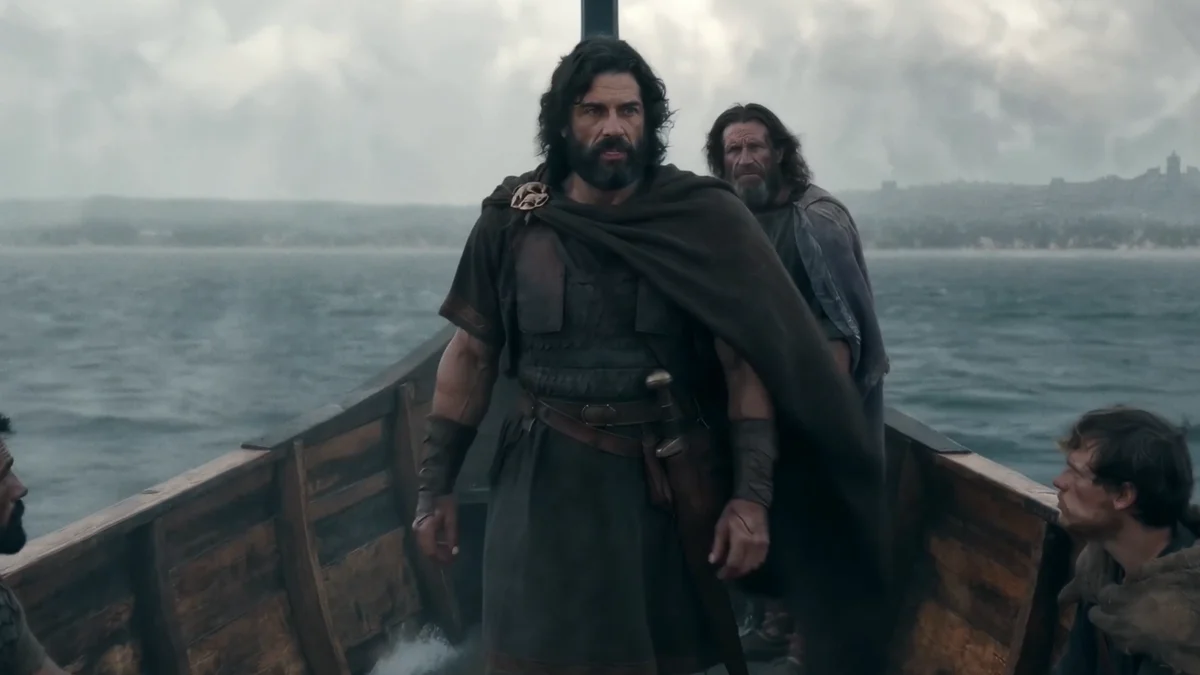
Seven minutes is enough time to introduce a warrior, show a fleet of ships and establish the beginning of a legendary journey.
It is considerably less time than a feature-length film requires.
That difference defines the latest development in Elon Musk's AI filmmaking ambitions.
On October 23, 2026, the official Grok Imagine account on X published the first episode of an audiovisual adaptation of Homer's Odyssey.
The video was created using Grok Imagine in collaboration with Wonder Studios and director Dev Walker.
It arrives three months after Musk promised an entire AI-generated movie before the end of 2026.
The episode is real, publicly accessible and relevant to the development of generative video technology.
But it is not the finished feature that was originally announced.
The new episodic presentation also raises an unresolved question.
Has the production shifted from a single feature into a serialized project, or is this simply an early stage of the same ambition?
No official statement has yet provided a definitive answer.
What happens in the first AI-generated Odyssey episode?
The video begins before Odysseus undertakes the return journey to Ithaca that forms the central narrative of Homer's poem.
It introduces events connected to his departure for the Trojan War.
Odysseus appears as a bearded warrior in a world of armor, ships and Mediterranean landscapes.
Penelope gives him a small wooden horse to bring home to their young son, Telemachus.
The exchange establishes a personal stake in a story that will involve war and prolonged separation.
The episode subsequently shows Greek military preparations, battle sequences and Telemachus growing older during his father's absence.
Much of the video is devoted to establishing the characters and explaining the circumstances of the conflict.
It does not present the complete succession of adventures associated with The Odyssey.
The encounters with the Cyclops, Circe and other mythological figures remain outside the material currently available.
The installment functions primarily as an introduction.
Its purpose appears to be establishing the setting and the character's journey rather than telling the entire story.
Musk originally promised a full-length movie
The initial announcement was considerably more ambitious.
In July 2026, Elon Musk stated that Grok Imagine would make a feature-length adaptation of The Odyssey before the end of the year.
He described the proposed film as historically accurate and faithful to Homer's work.
His declaration accompanied a shorter AI-generated demonstration posted by another X user.
The announcement did not merely describe a series of brief clips.
It explicitly presented a complete movie as the objective.
The October release represents a tangible but much smaller result.
The official Grok Imagine account calls it Episode 1.
No complete series duration has been announced.
The account has not confirmed the number of additional installments.
It has also not explained whether those episodes will eventually be assembled into a single feature film.
The original promise therefore remains separate from the content that has actually been released.
Wonder Studios and Dev Walker are credited as collaborators
The official publication reveals an important detail about the production process.
Grok Imagine does not describe the episode as something created without human involvement.
It explicitly credits Wonder Studios and director Dev Walker for their creative collaboration.
Both are associated with audiovisual production using artificial intelligence.
Their involvement matters because generating images is only one part of constructing a film.
Someone must decide which events to depict, how sequences connect and what information the audience needs.
There are also decisions about dialogue, framing, editing and dramatic rhythm.
The announcement does not explain how these responsibilities were divided.
It does not establish how many AI generations were required to produce the selected footage.
Nor does it provide a detailed account of manual corrections, additional software or post-production work.
It would therefore be misleading to claim that the episode was generated entirely from a single text prompt.
What is confirmed is that the video was made with Grok Imagine and involved identifiable creative collaborators.
Seven minutes do not prove that AI can produce an entire feature
One of the central challenges of generated video is the difference between producing a convincing image and maintaining a convincing story.
An AI system may be capable of generating an impressive ship, a detailed suit of armor or a realistic landscape.
Maintaining character continuity across multiple scenes presents another problem.
Audiences need to recognize protagonists and understand how their relationships change.
Objects, locations and visual details must remain sufficiently consistent to support the narrative.
Dialogue and performance also matter.
A film needs pacing, dramatic progression and scenes that sustain emotional interest.
Those challenges become more demanding as the duration increases.
A seven-minute episode can rely on relatively short sequences and narration explaining the action.
A feature must generally sustain attention for much longer.
The difference is therefore not simply the number of images required.
It involves constructing a coherent dramatic experience.
Grok's episode demonstrates an actual production using generative tools.
It does not establish that those tools can autonomously produce a complete, consistently coherent and artistically successful feature.
Some convincing visuals, but criticism of the storytelling
The initial professional responses highlight the gap between visual appearance and narrative effectiveness.
Writing for TechCrunch on October 25, Anthony Ha acknowledged that some shots were realistic enough to resemble conventional filmed footage for brief moments.
However, he criticized the dialogue, lengthy exposition and lack of dramatic momentum.
His review described characters who seemed to explain the story rather than convincingly inhabit it.
The Independent also reported negative reactions from viewers responding to the episode online.
Those observations should not be treated as a representative survey of the entire audience.
They do, however, show that the discussion involves more than image quality.
A realistic-looking scene may still lack dramatic tension.
A character can be beautifully lit and carefully costumed while failing to convey believable emotion.
The early reception therefore highlights an important distinction.
Creating moving images and directing a compelling story are related but different achievements.
What does historical accuracy mean for The Odyssey?
Musk's original description also deserves closer examination.
He promised a historically accurate adaptation faithful to Homer.
Yet The Odyssey is an ancient Greek epic that combines human societies with mythology.
Its story includes gods, monsters and extraordinary events.
Historical accuracy and literary fidelity are therefore not necessarily identical goals.
An adaptation might attempt to recreate ancient clothing or architecture while retaining the supernatural elements of the poem.
It might also reproduce the literary narrative without claiming to represent a precisely documented historical period.
The result depends on the creative choices involved.
In Grok's episode, the characters speak English.
That is not a reconstruction of the language used in ancient Greece.
However, translation is a normal feature of international storytelling and does not automatically make a literary adaptation unfaithful.
The relevant question is what the filmmakers mean by accuracy.
No detailed production notes accompanying the episode explain the criteria they intend to follow.
The original claim therefore remains difficult to assess comprehensively.
The project exists in the shadow of Christopher Nolan's Odyssey
Grok Imagine's adaptation did not emerge in isolation.
Its development followed the release of Christopher Nolan's cinematic adaptation of The Odyssey.
The movie opened in July 2026.
Its cast includes Matt Damon as Odysseus, Anne Hathaway as Penelope and Tom Holland as Telemachus.
Robert Pattinson, Zendaya and Charlize Theron are among the other performers.
Nolan's production involved extensive location filming and a large technical crew.
That does not mean it avoided all digital visual effects.
Its approach nevertheless placed substantial emphasis on physical filming, actors and practical production methods.
Musk publicly criticized aspects of Nolan's casting, particularly the involvement of Lupita Nyong'o and Elliot Page.
Those comments became part of a broader controversy concerning representation in cinema.
They are Musk's political and cultural opinions.
They do not establish that Nolan selected his performers to satisfy political requirements or influence awards eligibility.
The AI-generated project has consequently attracted attention partly because of this public conflict.
However, no official announcement identifies Grok's version as a commercial replacement for Nolan's film.
The production economics remain unknown
The contrast between the two projects also raises questions about cost.
A conventional large-scale film involves performers, sets, production crews, equipment and substantial periods of shooting.
AI-assisted production operates through a different combination of computing resources and creative labor.
But the necessary information for a reliable financial comparison has not been disclosed.
Grok Imagine has not published a detailed budget for the episode.
It has not revealed the total computing resources consumed or the number of discarded generations.
The costs associated with Wonder Studios and its collaborators are also unknown.
It would therefore be misleading to suggest that the entire production cost only a few dollars.
A public price for generated video does not capture the complete cost of writing, editing, revision, sound and creative direction.
Nor does a straightforward calculation of the cost per generated second establish the budget required to sustain quality across a feature.
For movie studios, the implications could eventually be significant.
More reliable generative tools might change certain production and pre-production workflows.
However, this first episode offers no verified basis for calculating the financial consequences at industry scale.
A public experiment rather than an established distribution model
The way Grok Imagine released its episode is notable.
The video appeared directly on X.
It was not announced as a theatrical premiere or a release on a conventional streaming platform.
The account explicitly called it the first installment of a series.
It also invited audiences to request a breakdown of how the production was made.
The episode therefore has two functions.
It is an audiovisual work designed to be watched.
It is also a demonstration of the capabilities of Grok Imagine.
Those purposes attract different audiences.
Some viewers may be interested in a new adaptation of Homer's story.
Others will watch primarily to evaluate the development of generative video tools.
The approach currently resembles a public technical and creative experiment more than a conventional film distribution strategy.
No comprehensive release arrangement has been announced for future installments.
The confirmed distribution channel for the first episode is X.
There is no confirmed schedule for the remaining episodes
The first Grok Imagine Odyssey episode was published on October 23.
No total episode count has been confirmed.
No weekly or monthly release schedule has been announced.
No theatrical distributor or streaming partner has been identified for a potential feature-length version.
The production has also not confirmed that another seven-minute installment is already complete.
It would therefore be premature to describe the release as the beginning of a fully scheduled television series.
Musk's original deadline was the end of 2026.
As of October 26, that deadline has not yet passed.
But completing a feature remains a stated ambition rather than an established result.
To fulfill the promise, the project would still need to demonstrate that it can complete and sustain a much longer narrative.
What Grok's first Odyssey actually demonstrates
The October release has one clear advantage over the original announcement.
Audiences can now examine actual footage rather than discuss only a promise.
The episode contains characters, environments, movement and recognizable narrative events.
It also openly acknowledges human creative collaborators.
That makes it a concrete AI-assisted audiovisual production.
However, it does not demonstrate completion of the promised feature or complete autonomy in filmmaking decisions.
Instead, it leaves important questions unresolved.
Character continuity, dialogue, pacing, production cost and long-form narrative coherence remain central challenges.
Cinema involves more than generating plausible images.
It also requires the organization of time, emotion and dramatic consequence.
Those are the qualities future generative productions will have to demonstrate if they are to compete seriously with established filmmaking methods.
For now, Grok Imagine has delivered seven minutes of The Odyssey.
The more demanding test will begin when the technology has to sustain a story long enough for audiences to stop evaluating the images and become absorbed in the film itself.