
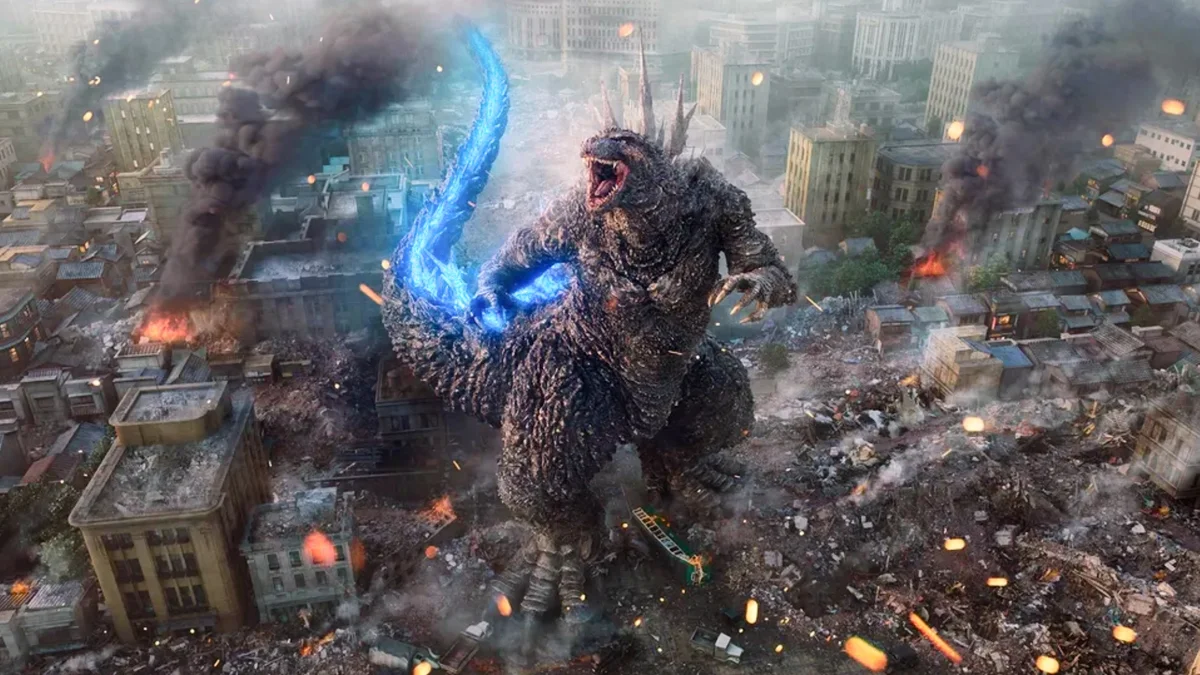
A country already devastated faces another catastrophe
Japan is barely beginning to recover from World War II. Its cities bear the scars of bombing, families are struggling to rebuild, and survivors are trying to discover what they can still hope for.
Takashi Yamazaki introduces Godzilla into this already shattered world.
The title expresses the premise directly. War has reduced Japan to zero, and the arrival of the monster threatens to push the country even further below that point.
Godzilla Minus One is therefore not simply about a new disaster. It is about what happens when people who have already lost almost everything are forced to confront another seemingly impossible tragedy.
Released in Japan on November 3, 2023, the film returns to the darkest foundations of the franchise.
Where some recent American productions have treated Godzilla as a spectacular action character, Yamazaki restores the traumatic significance associated with Ishirō Honda's 1954 original.
This Godzilla is neither a reluctant protector of humanity nor a creature primarily designed to fight other monsters.
He represents an overwhelming destructive force that threatens people whose lives have already been transformed by war.
That decision gives the film dramatic purpose.
The monster does not interrupt a prosperous society merely to demonstrate its vulnerability. He attacks a population that is desperately trying to begin living again.
Kōichi Shikishima believes survival has made him a coward
The central character is not a conventional military hero.
Kōichi Shikishima, played by Ryunosuke Kamiki, is a former kamikaze pilot consumed by shame because he survived the war.
During its final days, he refused to complete his suicide mission.
An early encounter with Godzilla on Odo Island leaves him paralyzed by fear, and the consequences of his hesitation become another source of guilt.
The story begins with a devastating contradiction.
Shikishima survived a conflict that demanded some young men give their lives for their country, yet he believes his survival represents a personal failure.
Yamazaki makes that guilt central to the drama.
Every attempt to rebuild his life is undermined by the conviction that he does not deserve happiness or peace.
Kamiki brings genuine intensity to this internal conflict.
His performance moves between anger, exhaustion, panic and fragile determination.
Shikishima is not naturally courageous. He must learn how to act in a world where he no longer understands the value of his own existence.
This distinguishes the film from many disaster blockbusters.
The protagonist is not trying to demonstrate that he is exceptional enough to save humanity.
He must first accept that he never needed to die in order to deserve the right to live.
Simon Abrams's review at RogerEbert.com recognized the movie's strong melodramatic ambitions while questioning its conventional storytelling.
That tension is important. The franchise has recovered genuine human gravity, but it expresses that gravity through familiar devices associated with classical popular cinema.
Noriko and Akiko offer the possibility of a new family
Returning to Tokyo does not mean returning to a normal life.
The country lies in ruins, and the family relationships that once defined Shikishima's existence have disappeared.
He meets Noriko Ōishi, played by Minami Hamabe, who is caring for an orphaned little girl named Akiko.
Together, they gradually form an improvised household amid the devastation.
This relationship provides the emotional foundation of the movie.
The characters have not chosen the circumstances that brought them together, but they begin building something resembling a family.
Yamazaki does not present this development as an instant cure for Shikishima's trauma.
The character remains incapable of fully accepting the affection offered to him.
His memories and guilt make every possibility of happiness difficult to embrace.

The family story works because it gives the disaster recognizable stakes.
When Godzilla approaches Tokyo, he is not merely threatening buildings.
He is threatening fragile lives that the audience has come to understand.
There is nevertheless an important limitation in Noriko's characterization.
She is moving and sympathetic, but much of her narrative function involves helping Shikishima understand what he could lose.
Her own psychology and aspirations receive less attention.
Abrams raised this imbalance in his RogerEbert.com review, particularly regarding the development of the female characters.
The emotional relationship remains convincing, but Noriko would have benefited from greater independence within the story.
Godzilla has rarely been this frightening
The film's greatest spectacular achievement is restoring a profound sense of helplessness.
Godzilla is enormous, heavy and almost incomprehensible.
But his size is not what makes him truly terrifying.
It is his complete indifference to human lives.
He does not negotiate or display the familiar personality of a monstrous action hero.
He advances, destroys and creates catastrophes beyond the capabilities of those trying to stop him.
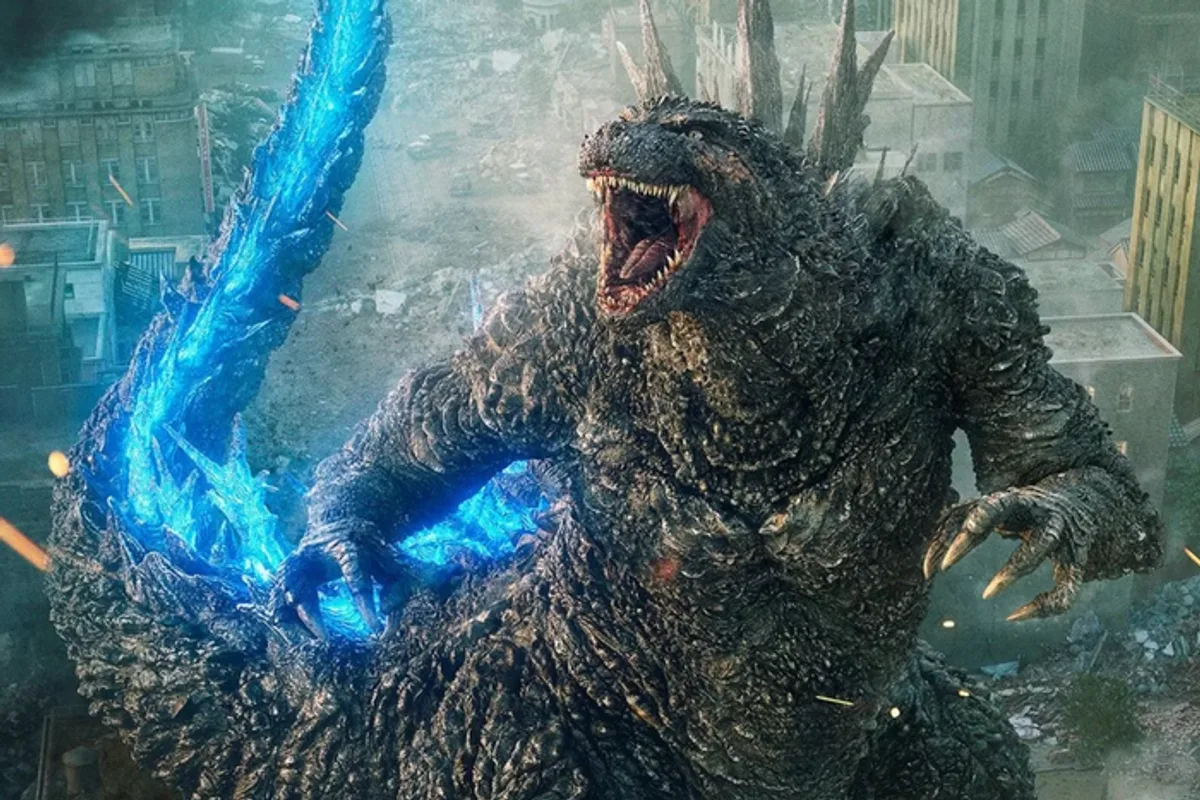
The creature's design reinforces that impression.
His body resembles burnt and fractured material, while his jagged dorsal plates recall the debris of bombed-out buildings.
The atomic breath restores the nuclear significance that has defined the character since the beginning.
It is not merely a powerful beam of light.
Its use becomes an event evoking the horror of mass destruction.
The Guardian's reviews particularly emphasized this return to the original meaning of Godzilla.
The monster functions as both a physical danger and an embodiment of Japan's collective postwar trauma.
The symbolism is direct, but it is also fundamental to the character's history.
Godzilla is rarely more compelling than when he represents something more significant than his physical strength.
The ocean pursuit is a masterclass in cinematic tension
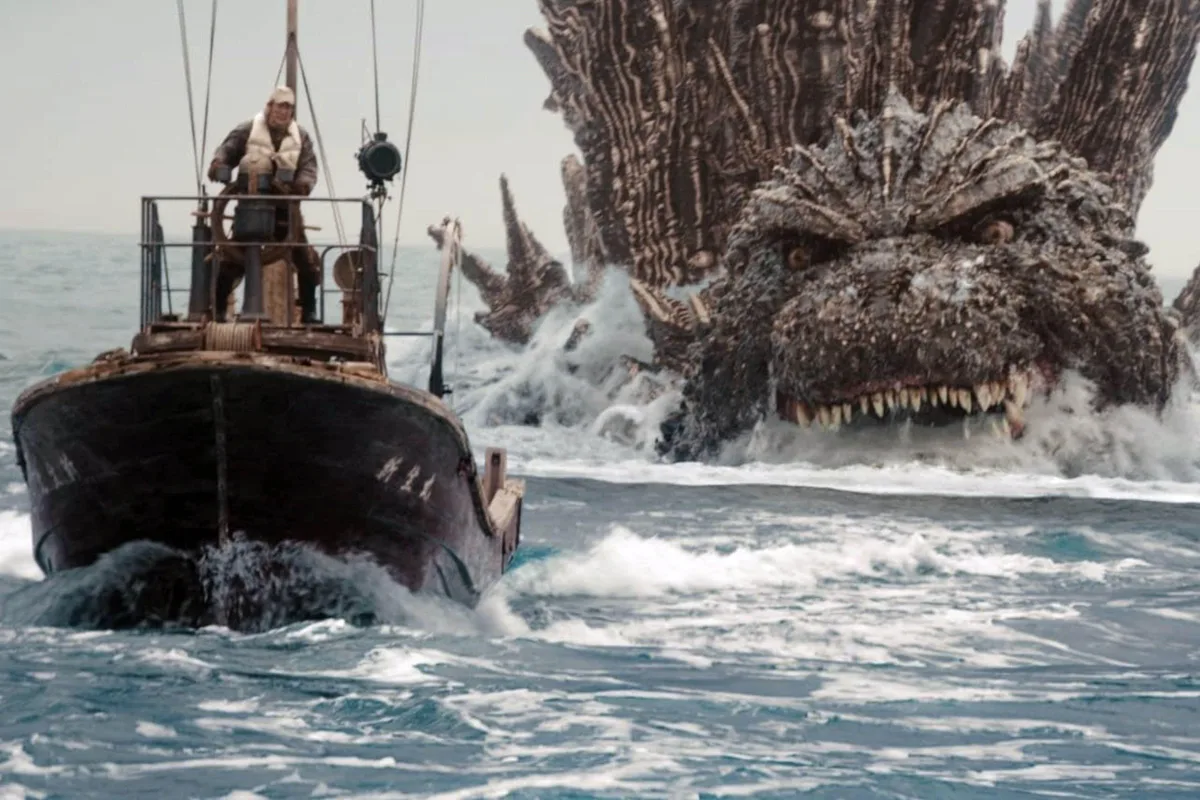
One of the movie's most memorable scenes places Godzilla against a small boat being used for minesweeping operations.
The imbalance is immediately understandable.
On one side is an enormous creature capable of destroying the vessel with little effort.
On the other are a handful of men with limited equipment and almost no realistic chance of overpowering it.
The filmmaking uses physical space brilliantly.
The movement of the boat, the rough water, the creature's proximity and the crew's improvised decisions become sources of extraordinary suspense.
Comparisons with Steven Spielberg's Jaws are inevitable.
Yamazaki understands that fear depends not only on the size of a threat but also on the limited options available to those attempting to escape it.
The sequence also demonstrates how effective restrained visual storytelling can be.
The editing moves between human vulnerability and the monster's overwhelming presence without sacrificing the geography of the action.
Some contemporary blockbusters lose that clarity while attempting to create excitement through increasingly rapid cutting.
Here, every decision matters.
The suspense emerges from understandable distances and the conviction that a single mistake could prove fatal.
The Ginza attack makes urban destruction tragic again
Godzilla's assault on Tokyo's Ginza district represents another major achievement.
Yamazaki stages the destruction of an urban environment with remarkable precision.
Buildings collapse, public transportation becomes dangerous and civilians discover how little protection their surroundings can offer.
The director delivers impressive images while maintaining an awareness of the people threatened by them.
The destruction is not simply an exhibition of digital effects.
These buildings belong to a city whose inhabitants are struggling to reconstruct their lives after war.
The spectacle therefore acquires a tragic dimension.
Every destroyed street represents another loss of something people had worked desperately to recover.
The use of Akira Ifukube's classic Godzilla themes reinforces the connection with the franchise's historical identity.
Godzilla Minus One does not invent the visual power of the monster.
It restores a gravity that can sometimes disappear when large-scale destruction becomes routine entertainment.
The Academy Award for visual effects was well deserved
On March 10, 2024, Godzilla Minus One won the Academy Award for Best Visual Effects.
It was the first Japanese Godzilla film to receive that honor.
Takashi Yamazaki shared the award with Kiyoko Shibuya, Masaki Takahashi and Tatsuji Nojima.
The achievement drew attention to a production operating with resources far below the scale of Hollywood's most expensive blockbusters.
However, evaluating the effects exclusively in relation to the budget would miss their real accomplishment.
They are successful because they support the filmmaking.
Godzilla's enormous size becomes convincing through his interaction with water, buildings, vehicles and people.
His destructive movements appear to possess weight.
Individual images occasionally reveal the limitations of computer-generated imagery.
Within the motion and rhythm of the film, however, the overall effect remains extraordinarily persuasive.
The Oscar recognized more than technical resourcefulness.
It celebrated visual effects that contribute directly to suspense, atmosphere and storytelling.
Yamazaki demonstrates that clear artistic choices can be as important as financial scale.
The music gives the disaster an elegiac dimension
Naoki Sato's original score accompanies both the emotional devastation of the characters and the physical danger represented by Godzilla.
Its expansive orchestral passages emphasize grief, anxiety and the struggle to rebuild.
The film also incorporates historical themes by Akira Ifukube, whose compositions have been associated with Godzilla since his early cinematic appearances.
The contrast works particularly well.
Sato's score supports the human melodrama, while Ifukube's themes suddenly reconnect the film with the mythological power of the monster.
Sound design contributes equally to the experience.
The roars, movements and atomic attacks possess a force that makes the destruction feel physical.
Silence is sometimes just as effective.
A brief withdrawal of sound before catastrophe can create more dread than several seconds of explosions.
Occasionally, however, the music tells audiences too explicitly what they should feel.
This reflects one of the movie's broader limitations.
Its emotions are sincere, but the presentation can lack restraint.
The film's central message: survival is not shameful
The question of sacrifice runs through Shikishima's entire story.
He was shaped by a society that associated military duty with the willingness, and sometimes the obligation, to die.
His refusal to complete a suicide mission becomes a source of shame that survives long after the war ends.
The film challenges that understanding of honor.
A human life should not be regarded as a resource to be spent in the pursuit of national glory.
This gives Godzilla Minus One significance beyond its disaster-movie premise.
Confronting the monster offers an opportunity to define courage differently.
The objective is no longer to demonstrate worth through death, but to protect others while accepting the value of one's own existence.
The emphasis on a civilian-led response rather than a conventional military operation reinforces this interpretation.
The message is hardly subtle.
Several exchanges explain it with a degree of insistence.
Nevertheless, its emotional force comes from the connection with Shikishima's established trauma.
Redemption is not presented as the reward for a spectacular death.
It emerges from learning to accept life after catastrophe.
Powerful melodrama with some overly convenient choices
The film's principal weaknesses are closely connected to its emotional ambitions.
Yamazaki favors characters who express their convictions intensely.
Personal conflicts are underlined through explicit dialogue, extended reactions and musical passages carefully designed to accompany emotional development.
The approach belongs to a recognizable tradition of popular Japanese melodrama.
It often works extremely well, especially when Shikishima's guilt conflicts with his desire to build a family.
However, some developments feel arranged too carefully to deliver a predetermined emotional resolution.
Narrative conveniences occasionally soften the harshness of the world the film has established.
Variety's assessment, which praised the thoughtful screenplay while identifying awkward melodramatic moments, captures that imbalance.
RogerEbert.com offered a more qualified response, arguing that Yamazaki had made an effective movie without reaching the artistic singularity of the franchise's most inventive installments.
Those reservations are legitimate.
Godzilla Minus One is emotionally persuasive, but not always understated.
A patriotic perspective that deserves scrutiny
The film's political implications also require examination beyond its immediate message.
Godzilla Minus One clearly criticizes the idea that soldiers should treat their deaths as an achievement of national duty.
Its defense of human life is one of its strongest themes.
At the same time, the narrative concerns Japan recovering a sense of dignity after defeat, with ordinary people rediscovering their ability to act collectively.
This patriotic dimension is not inherently objectionable.
It can be understood as an effort to distinguish care for a population from loyalty to the institutions that led it into war.
However, the history of Japanese imperialism, military responsibility and the suffering caused in other parts of Asia does not occupy a central place in the story.
The film focuses predominantly on Japanese victims of war and their struggle to rebuild.
Recognizing this limitation does not require a drama about a specific group of survivors to tell the entire history of World War II.
The Guardian noted the film's national and sentimental approach in its original reviews.
Godzilla Minus One offers a sincere examination of trauma while remaining a fictional account shaped by a particular historical perspective.
That distinction enriches rather than invalidates an appreciation of the movie.
Shin Godzilla offers a revealing comparison
Comparing the film with 2016's Shin Godzilla helps clarify Yamazaki's approach.
Shin Godzilla used the monster to examine the political and bureaucratic machinery of a government facing an unprecedented disaster.
Its drama emphasized institutional procedures, emergency meetings and the difficulty of making decisions across competing agencies.
Godzilla Minus One adopts a nearly opposite perspective.
Its primary concern is not the response of the state.
It follows ordinary people traumatized by war as they confront a threat that established institutions appear unable to resolve.
One film operates as a modern political satire.
The other is a historical melodrama incorporating spectacular disaster sequences.
Shin Godzilla arguably demonstrates greater formal and political experimentation.
Godzilla Minus One offers more immediate emotional engagement through its central characters.
Preferences between them depend partly on what audiences expect from a Godzilla story.
This critical assessment favors the emotional strength and action filmmaking of Minus One while recognizing that Yamazaki's approach is more conventional.
Minus Color offers another way to experience the film
In January 2024, Toho released a black-and-white version titled Godzilla Minus One/Minus Color.
It is not a sequel or a different narrative, but a monochrome presentation of the 2023 feature.
The decision naturally strengthens the visual connection with the black-and-white original from 1954.
Its appeal extends beyond nostalgia.
In a November 2024 essay for RogerEbert.com, Matt Zoller Seitz praised the monochrome version for intensifying the film's sense of historical catastrophe.
Strong contrasts emphasize silhouettes, textures and ruined environments.
The devastation can appear closer to the visual language of historical postwar imagery.
Color remains essential to the theatrical version's identity, especially during scenes involving Godzilla's atomic energy.
The two versions therefore provide distinct visual experiences without changing the underlying story.
Minus Color demonstrates the richness of images that remain compelling even when their visual presentation is substantially altered.
Exceptional critical reception and a historic award
Godzilla Minus One attracted attention far beyond the established audience for giant-monster movies.
Its critical reception was exceptionally favorable.
Rotten Tomatoes records an overwhelming majority of positive reviews, while Metacritic assigns an aggregate score of 81 out of 100.
These figures indicate a broad consensus, but they do not replace examination of the arguments behind the reviews.
The strongest areas of agreement concern the human story, the terrifying portrayal of Godzilla and the effectiveness of the visual effects.
The disagreements mainly concern the melodrama, conventional plot developments and political implications.
The Academy Award victory in March 2024 provided further recognition.
Godzilla Minus One became the franchise's first winner of the Oscar for Best Visual Effects.
The achievement was symbolically important for a character whose cinematic history had begun seventy years earlier.
But the film deserves its reputation for more than technical accomplishment.
Its special effects support a story compelling enough to sustain interest between Godzilla's appearances.
Verdict: 9/10, a monster movie that rediscovers its purpose
Godzilla Minus One belongs among the franchise's greatest achievements.
Takashi Yamazaki understands that Godzilla does not need to appear constantly in order to dominate a movie.
The creature becomes more frightening when viewers understand the lives he threatens to destroy.
Ryunosuke Kamiki provides a moving central performance, while the filmmaking delivers several remarkably controlled action sequences.
The ocean pursuit, the destruction of Ginza, the atomic breath and the powerful sound design create spectacle far beyond what might be expected from the production's resources.
Most importantly, the film gives its human story genuine thematic weight.
Shikishima must learn that surviving was not a failure and that his worth does not depend on dying as a hero.
Narrative conveniences, occasionally excessive melodrama and insufficiently developed female characters prevent a perfect score.
Those limitations do not change the central achievement.
Godzilla Minus One combines terror, spectacle and emotion in a film that restores historical significance to the King of the Monsters.
Godzilla destroys cities.
The human story asks how survivors can still find a reason to live.