
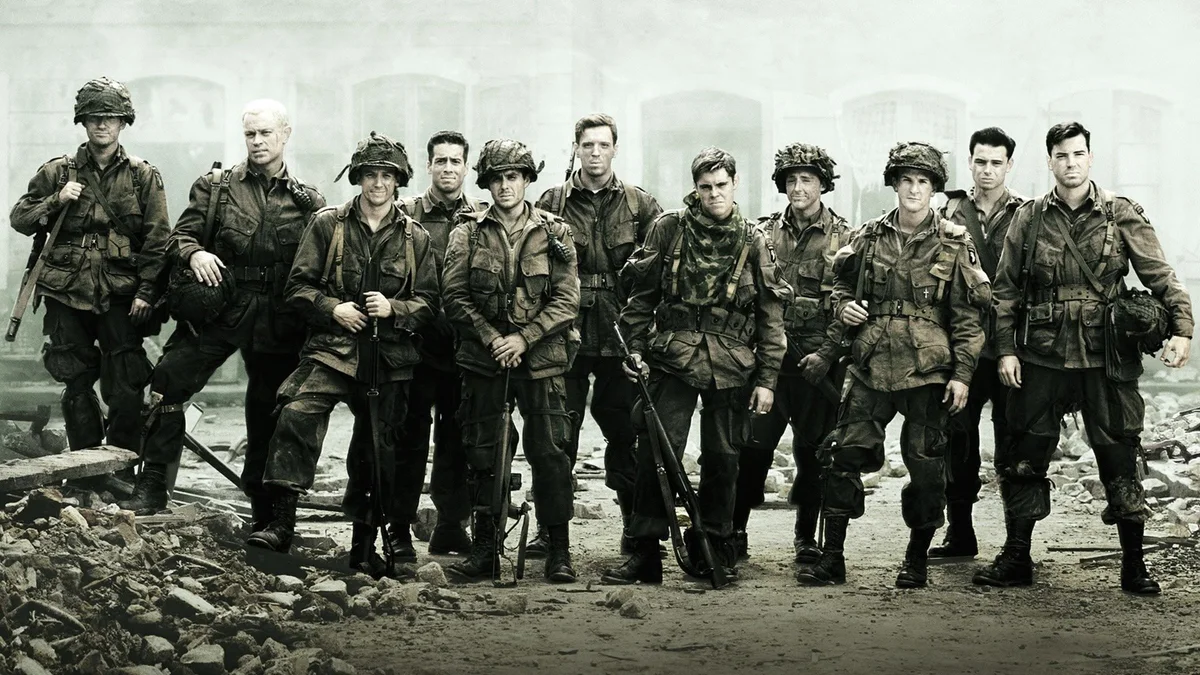
Twenty-five years later, its impact remains extraordinary
Band of Brothers premiered on HBO on September 9, 2001, just two days before the attacks that would transform the United States and profoundly affect the cultural context in which the miniseries was received.
A quarter of a century later, prestige television has changed dramatically.
Budgets have grown, elaborate visual effects have become commonplace, and large-scale historical dramas no longer seem as unusual as they did at the beginning of the century.
Yet Band of Brothers remains an exceptional achievement.
Its enduring power has little to do with nostalgia alone.
The ten-part adaptation of Stephen E. Ambrose's nonfiction book possesses a remarkable clarity of purpose.
It does not attempt to tell the entire story of World War II.
Instead, it follows one American parachute infantry company from training through the closing months of the conflict in Europe.
Produced by Tom Hanks and Steven Spielberg, the miniseries traces the experiences of Easy Company, part of the 506th Parachute Infantry Regiment of the 101st Airborne Division.
Its journey passes through Georgia, Normandy, the Netherlands, the Ardennes and eventually Germany.
The broad historical outcome is already known.
The suspense comes from something more immediate: whether the individuals inside the unit will survive the next hour, the next mission or the next winter night.
To mark its anniversary, HBO Max released Band of Brothers: Legacy on September 9, 2026, bringing cast members together to reflect on the production and the real soldiers who inspired it.
The commemoration provides an opportunity not only to celebrate the series, but also to consider why it has retained such an important place in television history.
War is experienced from the ground, not from a command map
One of the miniseries' greatest achievements is the discipline of its perspective.
Military plans and strategic objectives exist, but the men carrying them out rarely possess a complete understanding of the wider situation.
They know where they have been ordered to go.
They do not necessarily know where nearby units are located or how the enemy will respond.
This restricted viewpoint gives the action remarkable intensity.
The soldiers are not pieces moving across a map controlled by an all-knowing narrator.
They must improvise while frightened, exhausted and dependent on one another.
The second episode, Day of Days, offers a particularly effective example.
The airborne invasion of Normandy becomes a bewildering experience of darkness, antiaircraft fire and separated parachutists.
Survival takes priority over grand notions of battlefield glory.
The subsequent assault on the German artillery position at Brécourt Manor demonstrates a different kind of dramatic tension.
The action emphasizes terrain, tactical judgment and the consequences of individual decisions.
Even during chaotic combat, the staging generally allows audiences to understand where the characters are and what they are trying to accomplish.
That visual clarity remains impressive today.
War is frightening not merely because explosions are loud, but because every decision can expose another person to danger.
Damian Lewis portrays leadership without theatrical heroism
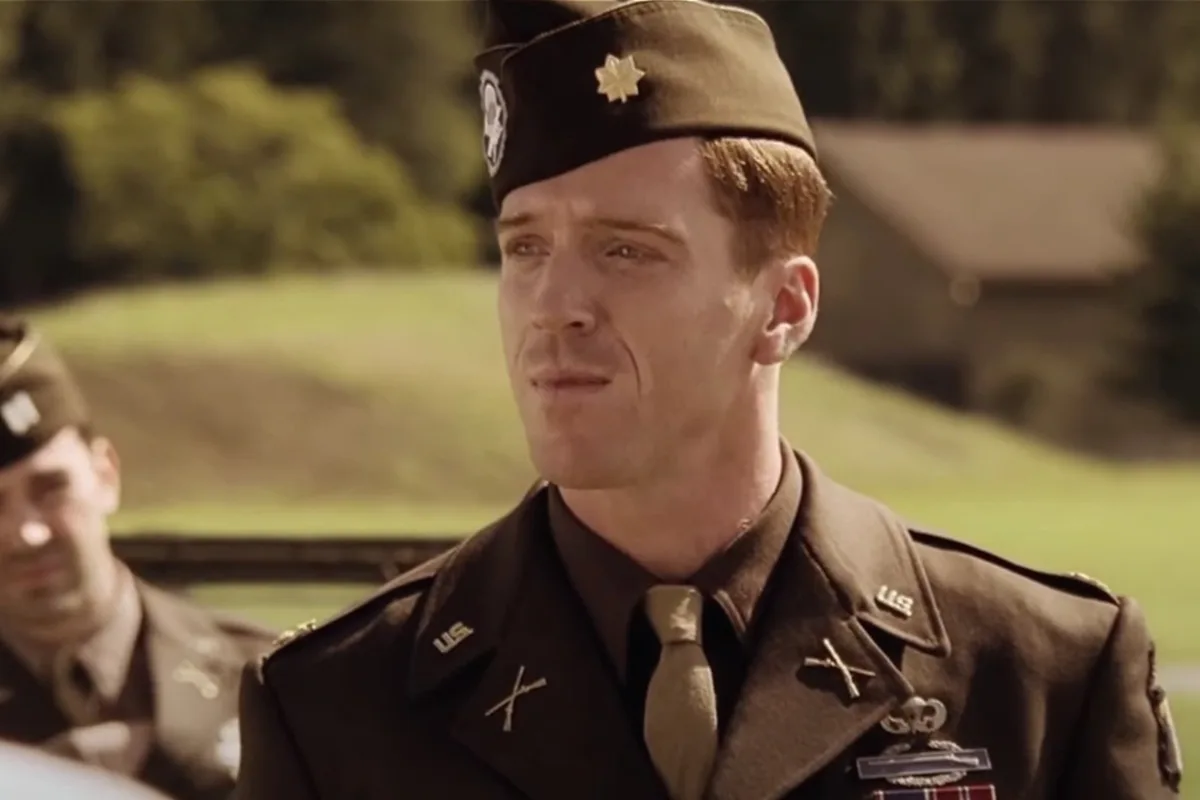
Richard Winters, portrayed by Damian Lewis, gradually becomes the central figure within the enormous ensemble.
He possesses qualities associated with an effective military officer: courage, discipline, responsibility and the ability to make decisions under pressure.
But the series rarely presents these attributes through grand speeches.
Winters establishes authority by acting, listening and accepting responsibility for his choices.
His calmness does not mean that he is unaffected by the circumstances.
The responsibilities of command become more difficult as casualties accumulate and expectations increase.
In his contemporary review for Salon, Gary Kamiya highlighted the restraint of Lewis's performance.
The actor makes an apparently ordinary and disciplined personality dramatically compelling without turning Winters into a conventional larger-than-life figure.
The character raises a question extending well beyond the military.
Why do certain individuals inspire trust when institutions and instructions can no longer provide sufficient reassurance?
Band of Brothers finds its answer in actions rather than declarations.
Winters earns the confidence of his men through the consistent relationship between what he expects from them and what he is prepared to do himself.
David Schwimmer presents the opposite model of authority
The opening episodes contrast Winters with Captain Herbert Sobel, played by David Schwimmer.
Sobel demands strict discipline and subjects Easy Company's recruits to exhausting training.
His methods contribute to the unit's physical preparation, but his behavior makes it difficult for his men to trust him.
The distinction between enforcing obedience and earning confidence becomes the source of the early dramatic conflict.
Schwimmer was already internationally recognizable through Friends, making his performance as the rigid and frequently intimidating officer particularly striking.
The character is not entirely one-dimensional.
His training contributes to the company's eventual effectiveness, even if his approach to leadership creates serious problems.
Nevertheless, the conflict feels somewhat more conventional than the complex situations the series later explores.
The opening episodes rely on a relatively clear opposition between two models of command.
Band of Brothers becomes richer when that distinction gives way to circumstances in which the correct decision is much harder to identify.
An enormous ensemble gradually becomes a recognizable company
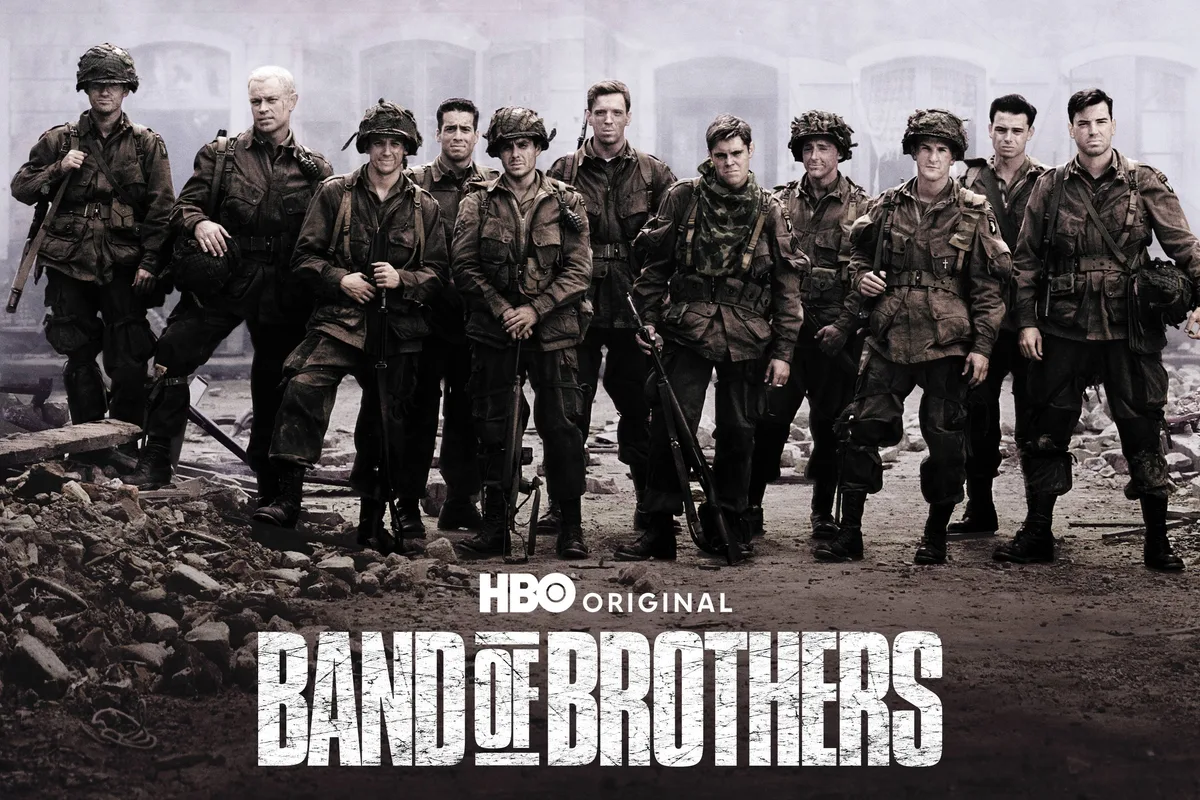
The cast remains one of the production's defining strengths.
Ron Livingston, Donnie Wahlberg, Scott Grimes, Michael Cudlitz and Neal McDonough appear alongside many other performers whose careers would continue to develop across film and television.
The ensemble also includes early appearances by actors such as Michael Fassbender, Tom Hardy and James McAvoy.
However, the number of characters initially creates a genuine obstacle.
Uniforms, helmets, military ranks and nicknames can make the soldiers difficult to distinguish.
Several episodes pass before the audience becomes fully familiar with the company.
Kamiya identified this problem in his 2001 review, arguing that the series' determination to preserve a collective perspective sometimes limited immediate emotional attachment.
That criticism remains reasonable.
The patience required by the opening hours is substantial.
Yet the approach eventually produces a remarkable reward.
Familiar voices become recognizable.
Small habits give individuals a distinct presence.
When a soldier is injured, disappears or returns after an absence, the emotional effect grows out of time spent alongside him.
The ensemble develops its identity through accumulation.
The audience learns the men in a way that resembles the formation of a real community: gradually, imperfectly and through shared experience.
Bastogne remains one of television's most powerful war episodes
The sixth episode, Bastogne, may be the clearest demonstration of the series' extraordinary emotional range.
It follows medic Eugene Roe, portrayed by Shane Taylor, during the bitter winter fighting of the Battle of the Bulge.
The freezing environment becomes a threat almost as relentless as enemy fire.
Supplies are scarce, casualties mount and medical care becomes a struggle against time and exhaustion.
The episode shifts attention from combat achievement to immediate human suffering.
A wounded soldier is not simply evidence that a battle is dangerous.
He is a person who needs help that may not be available.
The cold, the quiet and the difficulty of moving through the landscape create an atmosphere that feels almost physical.
Danger remains present even when no one is firing.
The episode also gives attention to forms of courage that are not associated with taking an enemy position.
Repeatedly caring for wounded men, remaining at one's post and enduring exhaustion can require extraordinary determination.
Bastogne builds its intensity without constantly resorting to heroic declarations.
It is precisely the kind of focused storytelling that makes the broader miniseries unforgettable.
The Breaking Point examines exhaustion and failed leadership
The seventh episode, The Breaking Point, provides another of the show's defining dramatic experiences.
Easy Company confronts the continuing consequences of the Ardennes campaign and the battle around Foy.
Shellfire, mounting casualties and problems within the chain of command threaten the cohesion of the unit.
The episode focuses on something war dramas can struggle to represent: accumulated exhaustion.
Experience does not eliminate fear.
A soldier who has survived several battles can remain just as vulnerable during the next attack.
Donnie Wahlberg's Carwood Lipton becomes particularly important here.
His ability to support the men illustrates that effective leadership does not always correspond perfectly to formal rank.
The company depends on people who maintain trust even when the official command structure becomes unreliable.
Some historical characterizations in this section, particularly that of Norman Dike, deserve caution.
The dramatization draws on recollections and a particular understanding of events rather than establishing a complete evaluation of every real officer's military career.
That limitation does not reduce the episode's emotional power.
It does, however, remind viewers that historical drama is constructed from selected perspectives.
Why We Fight changes the meaning of the entire journey
In Why We Fight, the soldiers encounter a Nazi concentration camp.
The discovery radically changes the moral context of what they have experienced.
For much of the series, the men concentrate on surviving immediate dangers and completing the next mission.
Their encounter with the camp confronts them with the scale of Nazi persecution and mass murder.
The episode avoids making the discovery a simple moment of moral triumph.
The soldiers' shock, confusion and practical difficulties receive substantial attention.
They are confronted with suffering that cannot be resolved through a conventional battlefield victory.
The narrative reminds audiences that the war was not only a sequence of military operations.
It was also a struggle against a regime responsible for systematic persecution and extermination.
The sequence is dramatically devastating.
However, the exact historical chronology of camp discoveries and the identities of the first units arriving at particular sites require more detailed research than a fictional reconstruction can provide.
The series is an important introduction to historical experience, not a documentary capable of establishing every factual detail on its own.
The real veterans give the dramatization its unique emotional authority
One of the production's most significant decisions was to include interviews with surviving members of the real Easy Company.
Their recollections appear around the episodes, connecting the fictionalized characters with the individuals whose experiences inspired them.
The effect is profound.
The actors' performances are no longer encountered solely as pieces of historical entertainment.
They become interpretations of lives that were actually lived.
The veterans describe memories of combat, lost comrades and moments that continued to affect them long after the war.
Their different voices give the series an unusually direct relationship with personal memory.
That relationship should not be confused with complete factual certainty.
Personal recollections are invaluable for understanding lived experience, but memories can be incomplete or contradictory.
Historical reconstruction requires additional sources and careful comparison.
The series' distinction lies in connecting emotional testimony with ambitious dramatic storytelling.
The interviews remind viewers that the people portrayed were more than characters within an exceptionally well-made television production.
Remarkable authenticity does not mean complete historical accuracy
Twenty-five years later, critical evaluation requires a distinction between the quality of historical reconstruction and the absolute accuracy of every detail.
The costumes, military equipment, battle environments and physical demands of the production demonstrate extraordinary care.
Yet identifiable historical errors remain.
The most frequently cited involves Albert Blithe.
At the end of Carentan, the series incorrectly states that he died in 1948 after failing to recover from his wounds.
In reality, Blithe continued his military career and died in 1967.
This is an important factual mistake within a production strongly associated with respect for historical testimony.
Other portrayals involving military officers and the precise chronology of certain events have also been questioned.
These issues do not invalidate the entire series.
They establish the limits of treating a dramatic adaptation as a definitive historical source.
Band of Brothers is based on real people, events and Stephen E. Ambrose's book.
It is not a complete scholarly account of every aspect of the company's military record.
The distinction matters precisely because the show is so influential.
For many viewers, it provides a first encounter with this history.
Its emotional credibility should encourage further learning rather than eliminate the need for historical verification.
An American perspective cannot tell the entire history of the war
A second limitation concerns the story's perspective.
Band of Brothers follows an American unit fighting in Western Europe.
That narrative decision allows the filmmakers to develop personal relationships across a sustained period.
It does not provide a complete account of World War II.
The experiences of Soviet soldiers, European resistance movements, colonial troops, civilians and many other Allied forces remain largely outside its scope.
This is not necessarily a dramatic failure.
A series following one company cannot be expected to represent every part of a global conflict.
The limitation becomes more significant when the production is treated as a definitive account of the war as a whole.
Some more recent critics have also highlighted the absence of minority perspectives and other American wartime experiences.
These observations should be part of any serious anniversary assessment.
Recognizing what the series does not cover does not diminish the importance of the soldiers it portrays.
It situates their experiences within a wider historical reality.
A remarkable account of one unit remains one perspective on an enormously complex conflict.
The production has aged extraordinarily well
Technical advances can make ambitious older television productions appear dated.
Digital effects become conspicuous, editing conventions change, and visual spectacle once regarded as revolutionary can lose its impact.
Band of Brothers has resisted that process remarkably well.
Its production depends heavily on physical environments, convincing military equipment and performers interacting with material surroundings.
The camera remains close to people running, falling, taking cover and trying to make sense of chaotic circumstances.
Explosions and battle movements possess a tangible quality that expensive digital imagery does not automatically reproduce.
The editing also knows when to allow silence and anticipation to become dramatic forces.
Waiting for an attack can be almost as unsettling as watching it take place.
Michael Kamen's music contributes substantially to the series' identity.
Its elegiac opening theme remains immediately recognizable.
In a less assured production, such music might have pushed the drama toward unnecessary sentimentality.
Here, it complements material whose emotional weight is largely earned through the experiences of its characters.
The result retains a cinematic scale that helps explain why Band of Brothers is regularly discussed among television's most important historical dramas.
HBO Max celebrates its legacy in 2026
HBO Max marked the twenty-fifth anniversary on September 9, 2026, with the release of Band of Brothers: Legacy.
Directed by former Green Beret Chase Millsap, the documentary returns to the making of the series and the influence of the real Easy Company on those who portrayed its members.
Participants include Damian Lewis, Ron Livingston, Michael Cudlitz, David Schwimmer and military adviser Dale Dye.
The documentary also features archival material relating to the real soldiers.
Tom Hanks and Gary Goetzman are among its executive producers.
Additional anniversary programming on HBO Max includes video diaries and material connected to the original series.
The documentary is not a new dramatic season.
It is a retrospective on the production and the historical lives behind it.
The anniversary offers an opportunity to consider the show's extraordinary cultural influence.
But commemoration should not turn the work into something beyond criticism.
Its most meaningful legacy comes from continued engagement with the people, the history and the questions it presents.
A series that encourages viewers to take memory seriously deserves to have its own representations examined with equal seriousness.
Verdict: 10/10 for an achievement greater than its imperfections
Giving Band of Brothers the highest score does not mean claiming that every historical detail is correct or every episode equally effective.
The enormous cast complicates the opening hours.
The narrative remains focused on an American perspective, and some factual representations require correction or qualification.
Those are genuine limitations.
Nevertheless, the overall dramatic accomplishment is exceptional.
The structural confidence, collective acting, battle sequences and unforgettable episodes centered on Bastogne and the discovery of Nazi atrocities form an achievement very few miniseries have approached.
Most importantly, Band of Brothers celebrates solidarity without pretending that courage means the absence of fear.
Its characters do not become brave because they are incapable of feeling vulnerable.
They are brave because they must act while understanding the possibility of death, injury and irreversible loss.
The series rarely treats the death of a soldier as a convenient spectacle.
It communicates the abruptness of loss and the difficulty of carrying on afterward.
Its importance therefore extends beyond technical achievement or the prestige of the HBO brand.
It lies in the ability to communicate the human cost of war through relationships forged under conditions few people will ever experience.
Twenty-five years after its premiere, Band of Brothers remains essential television.
Its excellence is not the perfection of an error-free historical document.
It is the excellence of a miniseries that fulfills its dramatic and human ambitions with extraordinary consistency.