Few games move as effortlessly between a family gathering and a competition where every finishing position matters.
Mario Kart has always relied on a particular balance. Its rules are simple enough for almost anyone to understand quickly, yet its races create enough unexpected situations to encourage continuous improvement.
Mario Kart World carries that tradition forward on Nintendo Switch 2.
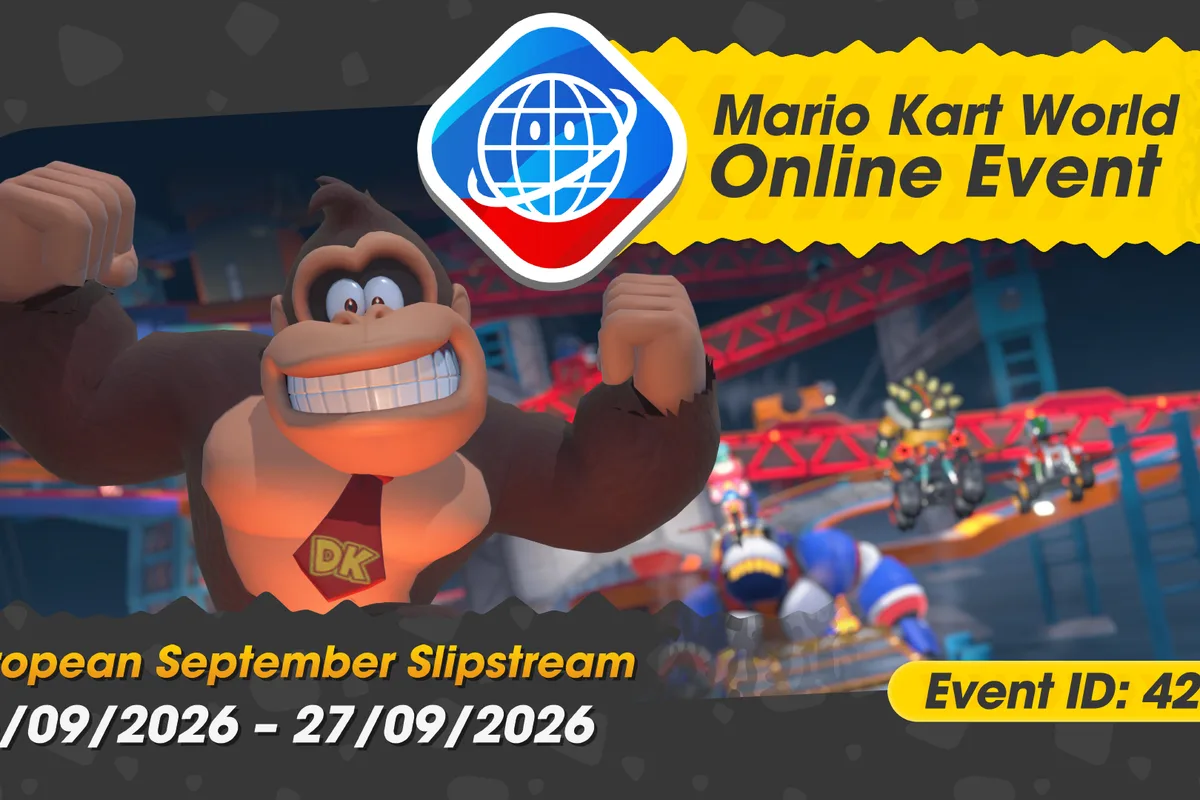
The European September Slipstream, held on September 26 and 27, provided another example. Nintendo published its official results on October 9, with a French competitor in first place.
France Takes the Lead in a European Ranking
The winner competed under the name LOLmdr.
With 10,209 points, the French player finished ahead of Italy's βλ☆DUGO, who recorded 10,037.
Another French competitor, Daisam, took fifth place with 9,713 points.
The leading results highlight the international nature of the competition. The top ten includes participants from France, Italy, the Netherlands, Germany and the United Kingdom.
Italy is particularly well represented, with four players among the top seven.
However, the competition should not be confused with a conventional esports championship featuring professional teams and a stage-based elimination bracket.
The European September Slipstream was an online competition integrated into Mario Kart World and open to eligible participants under Nintendo's published rules.
Why Mario Kart Works as a Competitive Game
Part of Mario Kart's cultural strength comes from its apparent simplicity.
The objective is immediately recognizable: race against other players and finish as high as possible.
Yet beneath that simple goal are numerous decisions. Players must manage their racing lines, understand the courses, respond to obstacles and react to unpredictable events.
Items introduce an element of chaos that distinguishes Mario Kart from more realistic racing games.
That unpredictability can be frustrating, but it also helps make individual races memorable stories.
The gap between a perfect racing line and an unfortunate projectile has long been part of the language shared by the game's community.
Consistency Matters Across Multiple Races
Every European September Slipstream participant began with a rating of 3,000 points.
Individual finishing positions increased or decreased that figure.
Players could compete throughout the weekend until the final scores were locked.
The format therefore differed from a tournament decided by one final race.
It rewarded repeated results, although rankings also depended on participation and the behavior of the rating system.
Nintendo did not present the event as a universal measurement of the best European Mario Kart player under every possible condition.
The final standings identify the strongest results obtained within this particular competition and its rules.
Individual Characters Develop Their Own Communities
One of the most interesting details in Nintendo's October 9 announcement is the publication of separate rankings for playable characters.
The company did more than identify the hundred highest-rated participants overall.
It also recognized players who achieved the best results with individual characters.
That distinction gives the tournament additional personality.
Some players identify with Mario, Luigi or Peach. Others prefer unexpected figures such as the Cow or the various supporting creatures that became playable in Mario Kart World.
For example, David from Germany leads the Cow rankings with 8,438 points.
French player Miaouryanc leads the Penguin rankings with 7,799 points.
The format creates more opportunities for recognition. A player might fall outside the overall top 100 while still having an impressive result with a favorite character.
Official Competition Without a Physical Venue
Nintendo's event was built around the accessibility of its online services.
To participate, players needed Mario Kart World on Switch 2, the latest software update and an active Nintendo Switch Online membership.
Eligible players using the seven-day free trial could also enter.
The tournament was available through the game's online menu using an event-specific code.
There was no need to travel to a competition venue.
This arrangement offers a form of competitive play somewhere between a community challenge, a seasonal leaderboard and a short official event.
It does not replace traditional esports competitions, but it makes official participation more accessible to players who already own the required hardware and subscription.
A Reward That Did Not Require a Podium Finish
Nintendo also offered 50 My Nintendo Platinum Points to participants who completed at least eight races.
That reward illustrates the event's broader approach.
The leaderboard recognized the highest-performing competitors, while a smaller loyalty reward encouraged wider participation.
Players with little expectation of reaching the top positions still had a reason to join.
The competition was therefore not designed exclusively as a spectacle for a small group of specialists.
It also encouraged the wider community to remain active throughout the weekend.
Nintendo Maintains an Accessible Competitive Culture
Mario Kart has long occupied a distinctive position among major multiplayer franchises.
Audiences do not need extensive prior knowledge to understand what is happening on screen.
A spectator can quickly identify the leader, notice sudden changes in position and understand why a dramatic finish produces strong reactions.
That clarity helps explain why the series remains popular among families, friends and public gaming events.
Mario Kart World extends this tradition through online functionality and races involving large groups of competitors.
The September Slipstream demonstrates how Nintendo can use those features to organize official competitive events without fundamentally changing the character of the game.
The Event Is Over, but the Community Continues
Nintendo did not announce an exact date for the next European event in its October 9 results article.
Instead, it encouraged players to follow the company's official channels for future competition announcements.
It would therefore be premature to describe the European September Slipstream as part of an already confirmed permanent championship.
What the event does demonstrate is the effectiveness of this format in giving visibility to an international community.
A French player finishes first, Italian competitors occupy several leading positions, and many other participants can explore both the main ranking and character-specific leaderboards.
For a franchise closely associated with friendly races and absurd items, that is an interesting development.
Mario Kart does not need to abandon its family-friendly identity to support meaningful competition. The European September Slipstream shows that it can provide both: chaos on the track and results that players take seriously once the finish line has been crossed.