
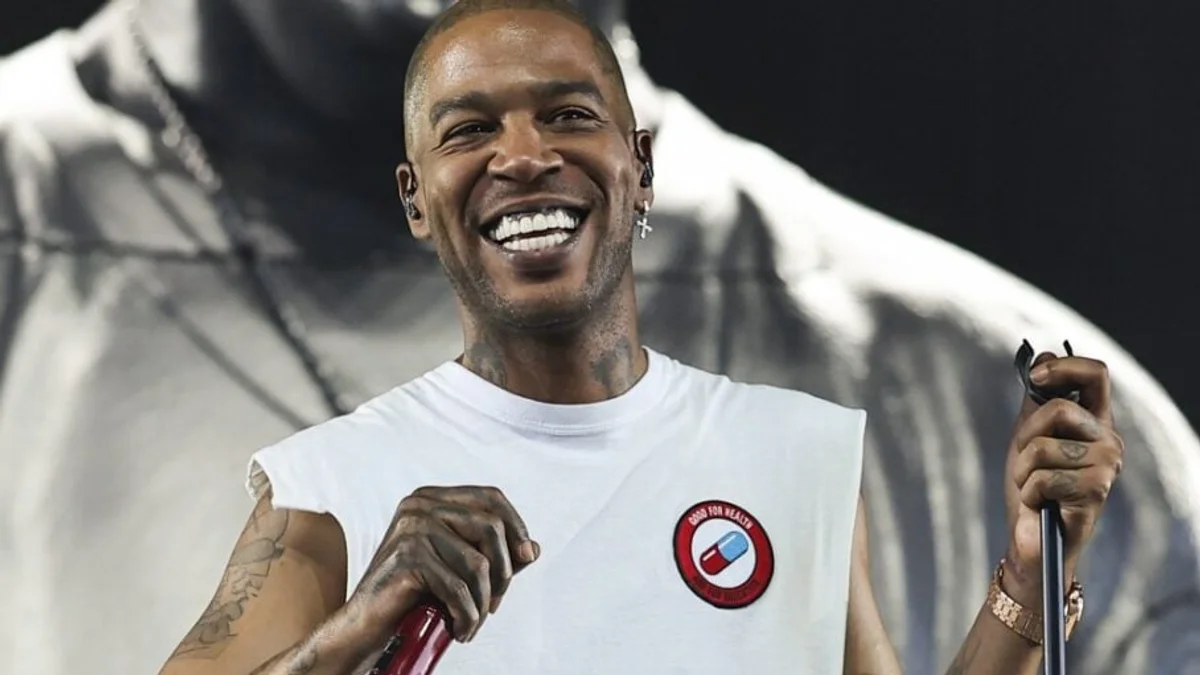
Some casting suggestions never become anything more than speculation. In Kid Cudi's case, one recurring comparison has inspired an entire film project.
For years, audiences suggested that the rapper and actor should portray Jean-Michel Basquiat, the influential New York painter whose work continues to shape contemporary art and popular culture.
But no production materialized from those suggestions.
Cudi has now decided to develop the film himself.
On October 21, 2026, the artist, whose real name is Scott Mescudi, announced Jean through Instagram.
He says he has written the screenplay and intends to direct and star as Basquiat.
Variety and Rolling Stone reported the announcement on October 22, confirming that Cudi plans to begin filming in 2027.
That date concerns the intended production schedule, not a theatrical release.
No distributor, complete supporting cast or premiere date has been announced.
The project is nevertheless notable because Cudi is not simply attaching himself to someone else's biographical drama. He wants to shape its story from the beginning.
Cudi wrote the screenplay instead of waiting for a casting offer
In his announcement, the musician explained that people had repeatedly suggested he should portray Basquiat.
The idea circulated for years without becoming a concrete film project.
Rather than continuing to wait, Cudi decided to write his own screenplay.
That decision puts him at the center of several creative responsibilities.
He is not only the proposed lead performer. He also intends to determine how the story is told and how it will be presented visually.
Cudi says the writing process involved extensive research, including books and conversations with people who personally knew Basquiat.
He describes the challenge of writing about a real individual as demanding but welcome.
His stated intention is to pay tribute to the painter, 1980s New York and the artistic environment that inspired him.
Those comments establish the project's personal importance to Cudi.
They do not establish the final structure of the screenplay.
It remains unclear whether Jean will cover Basquiat's entire adult life or concentrate on a particular period.
The characters who will appear alongside him have not been identified either.
The first photographs are wardrobe tests, not movie stills
Cudi accompanied the announcement with early images showing his intended transformation.
The photographs depict the musician in clothing inspired by Basquiat's distinctive style.
He wears a loose-fitting suit and a wig designed to resemble the painter's recognizable hairstyle.
The images immediately make the casting proposal more tangible.
However, Cudi has warned audiences that the look remains unfinished.
The wig is a preliminary experiment rather than the final hair design.
The clothing and other visual details may also change before production begins.
These photographs should therefore not be presented as stills from completed scenes.
They are preliminary characterization tests for a film that has not yet entered its announced 2027 filming period.
Physical resemblance can help establish credibility in a biographical performance, but it is only one part of the challenge.
Cudi will also need to interpret Basquiat's voice, body language, creative temperament and complicated relationship with success.
The quality of that portrayal cannot be judged from costume photographs alone.
Why Basquiat remains an extraordinary biographical subject
Jean-Michel Basquiat was born in Brooklyn on December 22, 1960, to a Haitian father and a mother of Puerto Rican heritage.
His artistic identity developed within the rapidly changing New York cultural environment of the late 1970s.
Graffiti, punk music, emerging hip-hop, experimental performance and visual art frequently intersected during this period.
Basquiat initially attracted attention through SAMO, the name he used with Al Diaz for enigmatic inscriptions appearing around Manhattan.
Those interventions belonged to a creative world operating largely outside established galleries and museums.
By the early 1980s, Basquiat was working on paintings that brought his imagery into a different setting.
His work combined human figures, crowns, anatomical references, fragmented words, historical allusions and recurring symbols.
The compositions often appeared deliberately unstable, as though several ideas were competing for attention on the same surface.
That visual complexity became part of his signature.
It also makes his life difficult to reduce to a conventional story of a young artist who became famous.
Basquiat's paintings addressed questions of racial representation, cultural power and the place of Black experience within historical narratives.
A meaningful biographical film would need to explore his artistic concerns alongside the dramatic events of his life.
The challenge for Cudi will be finding a cinematic language capable of reflecting that complexity.
The movie is intended as a tribute to 1980s New York
Cudi has described Jean as more than a portrait of one individual.
He also wants to celebrate the New York of the 1980s.
That ambition could give the film a broader cultural dimension.
The city was experiencing an unusually fertile period of artistic experimentation.
Painters collaborated with musicians, performers gathered in clubs and different creative communities influenced one another.
Basquiat was an active participant in that environment.
He played in the experimental music group Gray and maintained relationships with artists across several disciplines.
The connection with music creates a natural point of interest for Cudi.
His career includes songwriting, performance and audiovisual projects that combine different creative forms.
That experience might inform his interpretation of Basquiat's relationship with the New York music scene.
However, no soundtrack or composer has been announced.
There is also no confirmation that Cudi will write original music for the film.
Those creative decisions remain separate from the currently verified announcement.
Andy Warhol could be important, but his presence is unconfirmed
Basquiat's relationship with Andy Warhol is among the best-known chapters of his career.
The two artists formed an important connection during the 1980s and collaborated on several works.
Their partnership brought together artists from different generations and stages of recognition.
Warhol was already an established figure in contemporary art.
Basquiat was emerging rapidly within the New York art world.
Their relationship therefore offers obvious material for a biographical drama.
However, Cudi has not announced that Warhol will appear in Jean.
No performer has been attached to the role.
The production has not revealed whether their collaboration will occupy an important part of the screenplay.
It would be a mistake to treat familiar elements of Basquiat's real biography as confirmed scenes in the forthcoming film.
Cudi could choose a narrower period or a different narrative emphasis.
The project's structure remains unknown.
Kid Cudi has already established an acting career
Although best known for his music, Cudi has appeared in film and television for many years.
He played a role in HBO's How to Make It in America, which premiered in 2010.
His later screen credits include Need for Speed, Don't Look Up and Ti West's horror film X.
He has also developed projects that combine music with visual storytelling.
Entergalactic, released on Netflix in 2022, is a particularly relevant example.
The animated romantic production was connected to his album of the same name and reflected his interest in building a broader artistic world around music.
Jean presents a different kind of responsibility.
Basquiat was a real individual whose appearance, artworks and public statements remain extensively documented.
The performance will inevitably be compared with existing photographs and archival material.
Directing the movie introduces another challenge: representing the creation of visual art convincingly without turning the painting process into artificial spectacle.
Cudi is also developing a feature film titled Doe, which entered production in 2026.
That project is described in industry reporting as his feature directing debut.
Jean should therefore not automatically be called his first film as a director.
The eventual release order of the two projects has not been established.
Basquiat has been portrayed on screen before
Jean will not be the first biographical film devoted to the painter.
In 1996, Julian Schnabel directed Basquiat, starring Jeffrey Wright as the artist.
David Bowie portrayed Andy Warhol in that production.
The film explored Basquiat's entry into the New York art scene, his growing fame and the relationships that shaped his career.
Other documentaries and dramatic projects have examined different aspects of his life.
The Collaboration, adapted from a stage play about Basquiat and Warhol, is another project associated with his screen legacy.
Cudi's proposed film must therefore distinguish itself from existing portrayals.
The musician says he wants to tell Basquiat's story in a way audiences have not previously seen.
For now, that is a creative ambition rather than a measurable achievement.
The screenplay has not been released, and no completed footage is available for comparison.
Its distinctive approach might emerge from the selected period, the visual direction or the perspective of a contemporary musician.
Those remain possibilities, not confirmed production details.
The artist's legacy should not be reduced to his early death
Basquiat died on August 12, 1988, at the age of 27.
His death from a heroin overdose has become a recurring element in accounts of his career.
But focusing exclusively on that tragedy would overlook the extraordinary artistic achievement of his short life.
Basquiat developed an original visual vocabulary, participated in internationally significant exhibitions and transformed the relationship between street-influenced imagery and established contemporary art institutions.
His paintings examined race, identity, historical representation and the systems through which cultural authority is established.
Institutions including the Whitney Museum of American Art and New York's Museum of Modern Art continue to study and display his work.
His influence is therefore not confined to his biography or to the celebrity surrounding his name.
The strongest possible approach for Jean would give equal importance to Basquiat's creative achievements and the pressures of his rapid rise.
Whether Cudi's film will accomplish that remains unknown.
His announcement nevertheless indicates a personal admiration for the painter's work and the creative environment in which it emerged.
Filming is planned for 2027, without a release date
The project's confirmed calendar remains limited.
Cudi intends to begin filming Jean in 2027.
No specific month or production location has been announced.
There is no confirmed theatrical distributor or streaming platform.
The budget, financing partners and supporting cast have not been publicly detailed.
Neither a festival premiere nor a commercial release date has been established.
The Basquiat estate's involvement or approval has also not been confirmed.
Cudi's discussions with people who knew the artist do not, by themselves, establish a formal agreement with his estate.
The costume photographs released in October represent early character development rather than evidence that principal photography is underway.
The current announcement establishes an artistic plan, a written screenplay and an intended production year.
Several practical steps remain before Jean can be regarded as a completed or scheduled theatrical release.
A personal tribute that still has to become a finished film
What makes Jean interesting at this stage is not a large announced cast or an ambitious release calendar.
It is the project's origin.
Cudi says Basquiat has influenced him throughout his career and that he wants to tell the painter's story himself.
He did not describe receiving an irresistible offer from a major studio.
Instead, he says he wrote the screenplay because no existing opportunity had become reality.
That motivation gives the project a personal identity, although enthusiasm does not guarantee a successful film.
The screenplay will need to transform research into believable characters and dramatic structure.
The performance must extend beyond an appealing physical resemblance.
The direction will need to recreate a particular New York cultural moment without treating its people as a collection of recognizable images.
For now, Jean remains a film project with production planned for 2027.
But the premise offers an intriguing meeting of artistic generations: a contemporary musician seeking to portray a painter who helped transform the boundaries between street culture, gallery art and popular expression.
Whether that admiration becomes a compelling film is the challenge still ahead.